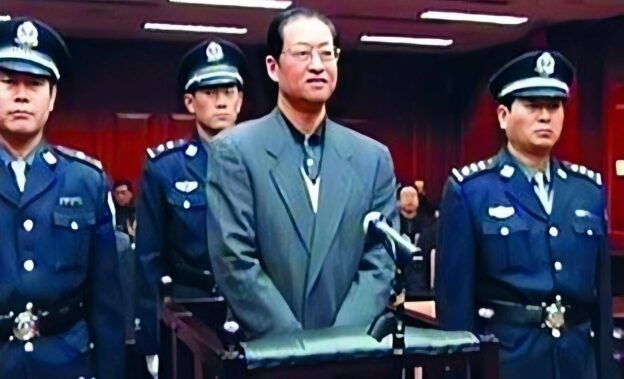
The Wang Huaizhong case was the third case of a provincial-ministerial-level corrupt senior official sentenced to death since the reform and opening up. Unlike Hu Changqing and Cheng Kejie, Wang Huaizhong’s trajectory of corruption bore a stronger “proactive” character: he did not passively accept “sugar-coated bullets,” but used his power to actively solicit bribes, and even after sensing an organizational investigation, attempted to use the huge sums he had solicited to “settle” the investigation. The following focuses on the course of the case and the key criminal facts.
I. Career Beginnings and the Expansion of Power
Wang Huaizhong was born in August 1946 in Bozhou, Anhui. His career began in Fuyang. In March 1993, he became deputy secretary of the Fuyang Prefectural Party Committee and commissioner of the administrative office; in October 1995, secretary of the Fuyang Prefectural Party Committee; in February 1996, secretary of the Fuyang Municipal Party Committee; and in October 1999, he was promoted to vice governor of Anhui Province. It took Wang Huaizhong more than six years to rise from the local level to the provincial-ministerial level, and locally he had a reputation for “being able to rise.” But details later disclosed showed that this “ability to rise” largely depended on falsely reporting achievements and creating “image projects” to attract the attention of superiors. He once confided the truth to a county party secretary after drinking: “‘Being able to rise’ depends on ‘achievements,’ but the key is not to let the people see the achievements, but to let the leaders see the achievements.”
This distorted logic of promotion also shaped his way of using power while governing Fuyang: power was regarded as a resource that could be cashed in, and the targets of “cashing in” were mainly private entrepreneurs who needed his help.
II. The Course of the Crime: From “Small Money” to Massive Greed
According to the court’s final finding, Wang Huaizhong’s bribery activities were concentrated between September 1994 and March 2001, totaling 5.171 million yuan RMB, and another 4.8058 million yuan of property could not be explained as coming from lawful sources. Before elaborating, it is necessary to first explain a characteristic that runs through his criminal process: Wang Huaizhong’s bribery was not all “passive acceptance of money”; a considerable part of it was actively solicited, and even after the organization had already begun investigating him, he still solicited bribes without restraint.
(I) Early Period: Exchanging “Help” for Returns
The starting point of Wang Huaizhong’s bribery, by his own account, was a sum of money “in a box of beef and mutton” received before the Spring Festival in 1996. In a later interview with CCTV, he recalled that someone gave him a box of beef and mutton, with one or two ten-thousand-yuan notes wrapped in newspaper inside. “The first time I accepted it, I felt it was not right… over time this matter gradually faded.” After this “fading,” the boundary for accepting money quickly blurred.
Among the early criminal facts found by the court, a relatively typical one was handling release on bail for Yang Xiaoming, deputy chairman of Fuyang Feilong Leather Co., Ltd. In September 1994, Wang Huaizhong, using the convenience of his position as deputy secretary of the Fuyang Prefectural Party Committee and commissioner of the administrative office, instructed then-Fuyang Mayor Wang Hanqing and others to handle release-on-bail procedures for Yang Xiaoming, who was suspected of tax evasion. In December of the same year, he accepted 60,000 yuan RMB from Yang Xiaoming. The amount was not shocking, but the nature was already clear: using public power to “avert disaster” for an individual boss, with the return entering his own pocket.
In the following years, Wang Huaizhong’s “service targets” gradually became fixed on a group of local real estate development and industrial bosses in Fuyang. Using the authority of the municipal party secretary, he provided convenience to these people in matters such as land transfers, demolition and resettlement, reduction or exemption of urban construction supporting fees, and coordination of bank loans by chairing coordination meetings, signing reports, and giving instructions to relevant departments. In exchange, bribes flowed into his hands in cash many times.
(II) Middle Period: Deep Interest Bonding with Ma Ping and Lu Qiang
In Wang Huaizhong’s bribery network, Ma Ping, chairman of Fuyang Longteng Industrial Co., Ltd., and her husband Lu Qiang were among the targets with larger bribe amounts and the most frequent dealings. Between 1998 and 1999, Wang Huaizhong accepted a total of 1.1 million yuan RMB from Ma Ping and Lu Qiang on four occasions.
Behind this 1.1 million yuan was a series of specific exercises of power. In October 1998, when Longteng Company encountered demolition problems during the development of Jingxin Villa, Wang Huaizhong intervened and required relevant Fuyang departments to resolve them, afterward accepting 300,000 yuan. In January 1999, employees of Longteng Hotel smashed the glass display windows and vehicles of the White House Hotel; Wang Huaizhong required the Fuyang public security organs not to hold Longteng responsible, afterward accepting 400,000 yuan. In February of the same year, Wang Huaizhong signed opinions on Longteng Company’s “Report on the Construction of the Longteng Shopping Center,” requiring relevant departments to give support, and accepted another 200,000 yuan. In May of the same year, Wang Huaizhong called relevant leaders of Yingzhou District to handle the land use certificate procedures for Longteng Company’s Longteng Gas Station, and accepted another 200,000 yuan.
The time span of these four sums was only a little more than half a year. And this period was precisely the stage when the atmosphere in Fuyang’s official circles was tensest: Mayor Xiao Zuoxin was under investigation, and Wang Huaizhong himself was a member of the investigation team; at the same time, the central and provincial authorities were examining whether he could be promoted to vice governor. Wang Huaizhong himself admitted during trial: “Accepting 1.1 million yuan at this time—wasn’t I courting death?” But admit it as he did, he accepted the money all the same. This posture of still not stopping during the “danger period” already revealed his path dependence on cashing in power, far from something that could be explained by momentary luck.
(III) The “Escalation” of Solicitation: A 2 Million Yuan Transaction
If accepting money from Ma Ping and her husband still carried the inertial color of “doing things—getting returns,” then Wang Huaizhong’s largest solicitation of bribes was entirely for another matter: stopping the investigation.
Around 2000, the investigation by relevant departments into Wang Huaizhong’s suspected economic crimes had begun to close in. Wang Huaizhong did not choose to confess voluntarily, but attempted to “spend money to avert disaster.” He found a person who claimed to have connections and could help him “settle” the investigation by the relevant central authorities, and demanded 2 million yuan as operating expenses. The money came from a private entrepreneur. According to disclosures, after soliciting 2 million yuan in one go, Wang Huaizhong did not forget to “take a cut” of 800,000 yuan, handing the remaining 1.2 million yuan to the middleman for “opening channels.”
This circumstance later became an aggravating factor specifically emphasized by the Supreme People’s Court when approving the death sentence. The ruling stated: Wang Huaizhong, “in order to evade legal sanctions, during the period when relevant departments were investigating his suspected economic crimes, still continued to solicit bribes from others, and used the huge bribes solicited to attempt to obstruct the relevant departments’ investigation of his economic crimes; the circumstances of the bribery crime were especially vile, the social harm extremely great, and the crime extremely serious.” In other words, soliciting bribes was already a serious crime, and the purpose of the solicitation—interfering with the organizational investigation—qualitatively changed the nature of the case.
(IV) Huge Unidentified Property: Four Million Yuan That Could Not Be Explained
In addition to bribery, Wang Huaizhong also faced charges of holding a huge amount of property with unidentified sources. After the case came to light, investigative organs seized and froze RMB, foreign currency, deposit receipts, IOUs, gold and silver jewelry, jade articles, luxury watches, and other valuables belonging to Wang Huaizhong and his wife, totaling more than 10.85 million yuan RMB. After deducting the 5.17 million yuan in bribe proceeds and 880,000 yuan in lawful income whose source could be explained, there remained 4.8058 million yuan that Wang Huaizhong could not explain as coming from lawful sources.
Although this more than 4.8 million yuan was presented as an independent charge in the judgment, together with the bribery charge it outlined a more complete picture: during the years Wang Huaizhong governed Fuyang, the speed at which his personal wealth accumulated far exceeded any explanation based on lawful income.
III. The Case and Investigation: From “Shuanggui” to Death Sentence
The investigation of the Wang Huaizhong case was not accomplished overnight. On April 7, 2001, he was placed under “shuanggui.” Thereafter, the case went through a long investigation and transfer process. On September 30, 2002, Wang Huaizhong was criminally detained on suspicion of bribery, and the Supreme People’s Procuratorate filed the case for investigation; on October 14 of the same year, he was arrested.
The trial of the case was held in Shandong, with the Jinan Municipal People’s Procuratorate initiating the public prosecution. On December 10, 2003, the Jinan Intermediate People’s Court held a public hearing on the case. On December 29, the first-instance judgment was announced: Wang Huaizhong was convicted of bribery and sentenced to death, deprived of political rights for life, and had all personal property confiscated; convicted of holding a huge amount of property with unidentified sources and sentenced to four years’ imprisonment; the decision was to execute the death penalty, deprive him of political rights for life, and confiscate all personal property.
Wang Huaizhong refused to accept the judgment and appealed. On January 15, 2004, the Shandong Provincial Higher People’s Court issued a second-instance ruling, rejecting the appeal, upholding the original judgment, and submitting it to the Supreme People’s Court for approval in accordance with law. The Supreme People’s Court, upon review, held that the facts found in the first-instance judgment and second-instance ruling were clear, the evidence was reliable and sufficient, the conviction was accurate, the sentencing was appropriate, and the trial procedures were lawful, and therefore approved the death penalty in accordance with law.
IV. Judgment Result
Wang Huaizhong was sentenced to death for bribery and to four years’ imprisonment for holding a huge amount of property with unidentified sources; the decision was to execute the death penalty, deprive him of political rights for life, and confiscate all personal property. With the approval of the Supreme People’s Court, he was executed on February 12, 2004.
V. Several Key Details Behind the Case
Looking back at the course of Wang Huaizhong’s case, several details deserve to be examined separately; they explain the behavioral logic of this figure better than the numbers in the judgment.
First, the hidden connection between bribery and “achievements.” During his time in Fuyang, Wang Huaizhong on the one hand accepted bribes from real estate bosses on a large scale and opened the door wide for them in land transfers and reductions of supporting fees; on the other hand, he was keen on falsely reporting fiscal revenue and creating “image projects.” According to reports, the fiscal revenue reported by Fuyang City in a certain year reached more than 40 billion yuan, and in Woyang County there was even the absurd matter of taxpayers signing as “Qin Shi Huang,” “Clinton,” and “Yeltsin.” These two things seemed to go their separate ways, but in fact pointed to the same logic: achievements were chips for promotion, power was a tool for making money, and neither was responsible for local development or the livelihoods of the people.
Second, the absurdity of soliciting 2 million yuan to “settle” the investigation. Wang Huaizhong pinned his hope of stopping the organizational investigation on a middleman who claimed to have connections, and for this he did not hesitate to solicit huge sums from bosses. This exposed both his fear of the organizational investigation and his superstition that “connections” could override rules. Ironically, the money he used to “avert disaster” itself constituted a new and more serious criminal fact, and ultimately became an important basis for approving the death sentence.
Third, the chain reaction in Fuyang’s official circles. The Wang Huaizhong case was not an isolated incident. After it came to light, more than ten department-bureau-level cadres, more than ten county-division-level cadres, and a number of section-level cadres in Fuyang were investigated and dealt with for corruption one after another. His wife, Han Guirong, was also prosecuted for participating in accepting 1.2 million yuan in bribes and transferring and hiding property. The way a local “top leader” uses power will, to a considerable extent, shape the local political ecosystem; and what Wang Huaizhong left behind was clearly a situation that would take a long time to clean up.
In his final days, Wang Huaizhong told a reporter interviewing him that he was writing a confession, and had thought of a title: “How I Went from Orphan to Vice Governor, and from Vice Governor to Death Row Inmate.” This title itself may be the most concise summary of the trajectory of his life: a person who came up from the bottom lost his sense of boundaries in the face of power, and ultimately returned to the starting point in a highly undignified way.