I. Introduction
In November 2003, with the capture in Cangzhou, Hebei, of a homely Henan-born man standing only 1.58 meters tall, a reign of terror that had lasted for years and cast a shadow over the rural areas at the junction of Anhui, Henan, Shandong, and Hebei finally began to dissipate. The man was Yang Xinhai. Starting around 2000, he roamed the remote villages at the junction of the four provinces on a bicycle, choosing the dead of night to pry open farmers’ door latches and carry out extermination-style killings of sleeping families. According to the court’s final determination, he committed 26 crimes, killing 67 people, injuring 10, and raping multiple women. The case was listed by the Ministry of Public Security as the No. 1 supervised case of 2003. Its long span, cruel methods, and large number of victims are extremely rare in the history of contemporary Chinese criminal cases.
II. Yang Xinhai: From “Honest Child” to Murderous Demon
To understand how this series of bloody cases came about, it is necessary first to understand Yang Xinhai’s life trajectory. Yang Xinhai was born on July 17, 1968, in East Team, Yangtaozhuang, Zhangjia Village, Runanbu Township, Zhengyang County, Zhumadian City, Henan Province. He was 1.58 meters tall and had a junior high school education. His family was among the poorest in the village. His father, Yang Junguan, and mother, Yang Zhan, lived in a mud-brick thatched house whose roof had to be covered with plastic sheeting when it rained. Yang was introverted from childhood and did not like to talk, but he loved to draw—”whatever he drew looked like the real thing.” In the impressions of villagers and grassroots police, he “did not even dare to kill a chicken” as a child and was a diligent, honest boy.
Yang was the only person in his family to attend high school. While boarding at the high school in Youfangdian Township, other students could bring grain from home to exchange for meal tickets, but he often boiled wild vegetables or cooked his own food. In his senior year, he suddenly ran away from home. His family later learned that he had gone to work at a coal mine in Jiaozuo and then cooked for a construction team in Taiyuan. During his subsequent working life, he repeatedly encountered situations in which he worked but was not paid. Once, after a restaurant withheld his wages, he stole an aluminum basin from the restaurant—this was his first theft, and the first time he felt that “money could come easily.”
After that, Yang’s life slid onto a criminal track. In 1988, he was sent to re-education through labor for two years by the Baqiao Public Security Sub-bureau in Xi’an for theft; in 1991, he was again sent to re-education through labor for one year by the Chang’an Public Security Sub-bureau in Shijiazhuang for pickpocketing. Before his second re-education through labor, his girlfriend in his hometown had told him she would wait for him, but when he returned full of hope a year later, the girl had already married another man. In 1996, he was sentenced to five years in prison in Zhengyang County for attempted rape and was released early in 2000. After release, Yang was no longer that “honest child.” According to later police analysis, repeated re-education through labor and prison experiences, the humiliation of setbacks in work, the blow in love, and a growing resentment toward society together pushed him onto the path of retaliatory killing.
III. The Crimes
(1) Phase One: Blood First Appears in Southern Henan (2000–2001)
Yang’s first murder after release occurred near his hometown. In September 2000, in Guozhuang Village, Beijiao Township, Chuanhui District, Zhoukou City, Henan Province, a couple was brutally killed at home. At the time, this case was not immediately linked to the later series of bloody cases, but it marked a fatal turning point: Yang had shifted completely from property-oriented crime to violent crime centered on killing.
After that, he began to extend his range of operations to neighboring provinces. The locations he chose had highly consistent characteristics: remote villages far from towns, poor farming households, and simple two-panel wooden doors with easy latches. The time of the crimes was almost always fixed from late night to early morning. While the victims were asleep, he would use tools he carried or his bare hands to lift the door latch and sneak inside. After entering, he first attacked the adult male, usually striking his head with an axe or blunt instrument to kill him on the spot or deprive him of the ability to resist, and then dealt with the other family members one by one. In many cases, he left no survivors, not even children.
In 2001, Yang committed a crime in Fangcheliu Village, Juling Town, Linying County, Luohe City, Henan Province, killing 3 people and raping 1. In the second half of the same year, he killed 2 people in a village in Shiqiao Township, Linying County. The area around Luohe thus became one of the regions where he concentrated his crimes most heavily, which was also an important reason why the trial was later held in Luohe.
(2) Phase Two: Cross-Provincial Roaming and Frenzied Escalation (2002)
Entering 2002, the frequency of Yang’s crimes accelerated markedly, and his range expanded from Henan alone to the vast rural areas at the junction of Anhui, Henan, Hebei, and Shandong. His means of transportation was a bicycle, which allowed him to move along rural paths without attracting attention and quickly disappear into the night after committing a crime.
Xiping, Henan: Extermination and a Survivor
On October 22, 2002, a tragedy occurred in Mao Village, Songji Township, Xiping County, Zhumadian City, Henan Province. Villager Fan Chunhua and his 6-year-old daughter were killed at home, and his wife, Wu Qinghua, was seriously injured. Wu was rescued in the hospital for 45 days and ultimately survived, but the child in her womb was miscarried. The situation of “someone surviving” in this case was extremely rare in Yang’s criminal history, and precisely because of this, it left direct witness information about the killer’s method of operation.
Just over a month later, on December 6, 2002, another extermination case occurred in Liuzhuang Natural Village, Sanhe Village, Renhe Township, Xiping County, also in Zhumadian City. Villager Liu Zhanwei, his mother, wife, son, and daughter—a family of five—were killed. Liu Zhanwei’s 68-year-old father, Liu Zhongyuan, survived only because he lived in an adjacent new building as a caretaker. The killing of a family of five at the same time caused enormous panic in rural society. For a long time afterward, neighbors closed their doors tightly as soon as it got dark and did not dare to go out.
The Shangcai Blood Case
On November 8, 2002, a vicious case occurred in Gaoli Village, Shaodian Township, Shangcai County, Zhumadian City: 4 people were killed, 2 were raped, and 1 was seriously injured. The large number of victims and the egregious circumstances of this case further heightened the urgency for police to link the series of cases.
(3) Phase Three: The Final Frenzy in Hebei (2003)
In 2003, Yang’s criminal trajectory extended north into Hebei. Although he committed only two crimes in Hebei, both were extermination cases, and they occurred within just three days, bringing his frenzy to its peak.
Lidao Village, Xingtai: The Sun Shengjun Family
On August 5, 2003, Yang rode his bicycle to Lidao Village, Zhucun Town, Xingtai County, Hebei Province. That night, he sneaked into villager Sun Shengjun’s home and killed Sun Shengjun, his wife Li Shuzhi, and their 15-year-old daughter Sun Yuanyuan. Sun Shengjun’s son Sun Hongbo survived because he was not at home at the time. After the incident, Sun Shengjun’s younger brothers Sun Shengqi and Sun Aijun decided to demolish their elder brother’s house. “Since that happened, neighbors are afraid when they pass by this house, so we might as well tear it down,” Sun Shengqi said. On the day of the demolition, a fine rain began to fall. Sun Shengqi shed tears, pulled his younger brother, and said, “Let’s wait until the sky clears.”
Dongliangxiang Village, Shijiazhuang: The Wei Xianzeng Family of Five
Three days later, on August 8, 2003, Yang appeared in Dongliangxiang Village, Qiaoxi District, Shijiazhuang City. This time, he killed a vegetable farmer’s family of five: Wei Xianzeng, his wife Fan Yuhua, and their three children. From Xingtai to Shijiazhuang was only a little more than a day’s ride by bicycle. Yang did not flee far immediately after the crime but continued to wander in the nearby area. This unbridled state precisely shows that information sharing and joint investigation among the police of the four provinces were still in a period of adjustment and had not yet formed an effective network capable of restraining his roaming.
(4) Characteristics of the Crimes and Difficulties of Investigation
Looking back at Yang’s criminal trajectory, several characteristics deserve attention.
The extreme utilitarianism of target selection. Almost all the targets he chose were poor farming households in remote villages. In terms of financial gain, he obtained very little in many cases, sometimes only a few dozen yuan. However, it was precisely these families whose household defenses were weakest—low courtyard walls, simple two-panel wooden doors whose latches could be lifted from outside at night with a blade or thin iron sheet. He used no high-tech means and no special tools; his methods were primitive and direct. Forensic experts noted when analyzing the case: “He had no special method. He just waited until people were sound asleep, pried open the door latch, and went in.”
The violent logic of leaving no survivors. Yang’s method of killing had a clear “removing obstacles” logic: first kill the adult male to eliminate the possibility of resistance, then kill the remaining family members one by one, and finally sexually assault the female victims. This pattern meant that very few survived his crimes, which also meant that the eyewitness testimony available from the scenes was extremely limited.
Cross-provincial roaming and information barriers. Yang’s range of activity covered the junction of Anhui, Henan, Shandong, and Hebei, an area that geographically belongs to the Huang-Huai-Hai Plain, with dense villages, interlaced roads, and blurred provincial boundaries. After committing a crime in one province, he often quickly crossed by bicycle into a neighboring province, while at the time the police of the four provinces did not sufficiently link similar cases and share intelligence. In a CCTV “Time-Space Connection” program, forensic experts, when reviewing the case, admitted that if a cross-regional information platform had been established earlier, it “would have been conducive to solving the case.” This reflection reveals from another angle the structural reasons why Yang was able to continue committing crimes for years.
Concerns about “beating the grass and startling the snake” and the lack of public prevention. Before the cases were linked, some grassroots public security forces in the affected areas had reminded villagers to pay attention to safety through broadcasts and other means, but the methods were rather crude. Experts commented afterward that Yang’s methods were actually not complicated, and if the public had been informed through appropriate channels of the regular characteristics of his targets—remote, poor farming households with simple doors—it would “not have been very difficult” for the public to take precautions. However, out of concern about causing panic and “beating the grass and startling the snake,” the relevant information was not fully conveyed to the groups that most needed to know it.
IV. Capture and Interrogation
In August 2003, the Ministry of Public Security presided over a meeting in Henan attended by the criminal investigation departments of Anhui, Henan, Shandong, and Hebei, at which the series of related homicide cases were linked and internal materials were distributed to fully deploy arrest operations. The case was listed as the No. 1 supervised case of the Ministry of Public Security in 2003.
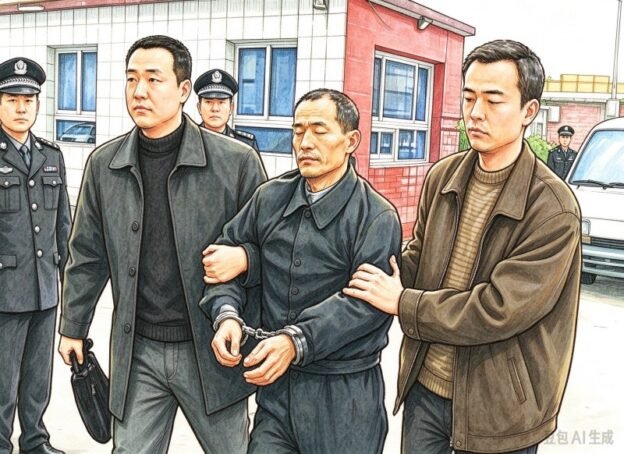
The turning point came on November 2, 2003. That day, the criminal police brigade of the Xinhua Sub-bureau in Cangzhou City, Hebei Province, received a lead: a Henan-born man staying in Room 205 of the Cangzhou Supply and Marketing Hotel had no ID card and was behaving suspiciously. The Xinhua Sub-bureau immediately organized forces to track and control him. At 10 a.m. on November 3, police officers arrested the man. After preliminary examination, he identified himself as Yang Xinhai.
Cangzhou police immediately sent Yang’s DNA sample to Shijiazhuang for comparison. On November 5, the Hebei Provincial Public Security Department issued a notice: Yang Xinhai’s DNA matched the DNA from biological evidence such as hair left at the scenes of multiple major homicide cases at a rate of 99.9999%, confirming that he was the suspect in the series of homicide, robbery, and rape cases in Anhui, Henan, Shandong, and Hebei. That evening, Yang began to confess to his crimes.
According to his initial confession, he committed 22 crimes in the four provinces, killed 65 people, seriously injured 5, and raped 23. As the investigation deepened and verification proceeded, the final confirmed numbers were adjusted. By the prosecution and trial stage, the procuratorate charged him with 26 crimes, 67 deaths, and 10 injuries.
V. Trial and Execution
In December 2003, Yang was transferred from Zhengzhou to the Luohe City Detention Center. Because his crimes were most concentrated in Henan and cases were frequent around Luohe, the trial location was set in Luohe.
On February 1, 2004, the Luohe Intermediate People’s Court of Henan Province tried the Yang Xinhai case. Given that the case involved victim privacy, the trial was conducted in closed session. The case files transferred by the procuratorate numbered more than 30 volumes. The prosecutor stated at trial that for every criminal fact, “everything must rely on facts, on evidence, and on the law.”
After trial, the court determined that Yang Xinhai had committed robbery, intentional homicide, rape, and intentional injury. He was sentenced to death for robbery, deprived of political rights for life, and had all his personal property confiscated; sentenced to death for intentional homicide, deprived of political rights for life; sentenced to death for rape, deprived of political rights for life; and sentenced to five years in prison for intentional injury. Under the principle of concurrent punishment for multiple crimes, the decision was to execute the death penalty, deprive him of political rights for life, and confiscate all his personal property.
After the verdict was pronounced, Yang stated in court that he accepted the judgment and would not appeal. After the 10-day appeal period expired, he did not file an appeal with the court. With the approval of the Henan Provincial Higher People’s Court, Yang Xinhai was executed in Luohe, Henan, on February 14, 2004.