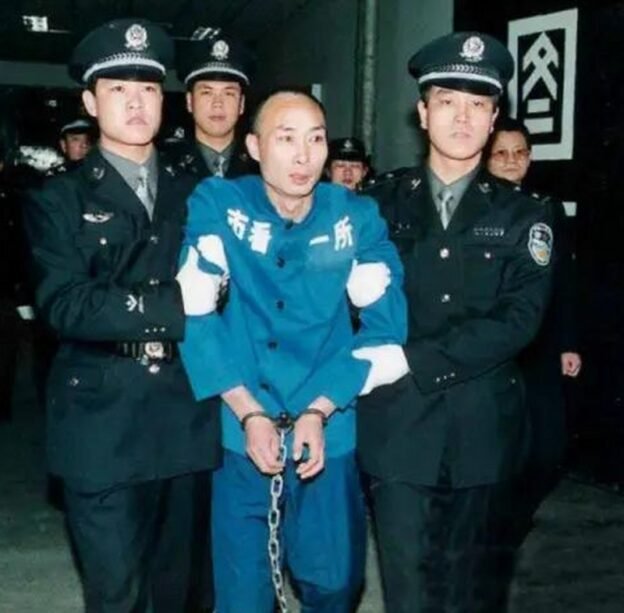
In the early hours of March 16, 2001, five explosions struck residential buildings in Shijiazhuang in less than an hour, killing 108 people and injuring 38. This case, the deadliest bombing since the founding of New China, was carried out by a deaf-mute man who had been released from prison just four years earlier and was utterly alienated from society—Jin Ruchao. His criminal trajectory was not complicated, yet a series of oversights that should have been intercepted ultimately turned into a massacre of innocent neighbors.
I. A Man “Toyed With by Society”
Jin Ruchao was born in December 1960 in Suqian, Jiangsu, and moved with his parents to Shijiazhuang at age 8, where he attended the school affiliated with the No. 3 State Cotton Mill. At around eight or nine, an illness caused him to lose his hearing, leaving him with a deaf-mute disability and slurred speech. This illness not only damaged his hearing but also profoundly shaped his relationship with the world. In the memories of factory colleagues and neighbors, Jin was withdrawn and violent-tempered, rarely interacting normally with others, yet he brooded over any perceived offense.
In 1988, Jin was sentenced to ten years in prison for rape. During his imprisonment, his wife divorced him. In August 1997, he was released after a sentence reduction, by then already 37. After release, Jin had no fixed job, no stable income, and no family. He worked in Hainan, Yunnan, and elsewhere to make a living, but was never able to integrate into normal social life. He lived in Room 201, Building 16, of the No. 3 State Cotton Mill dormitories, which his mother had left him, and conflicts with neighbors, his stepmother, his ex-wife, and her relatives continued to accumulate.
In prison, Jin wrote a large number of diaries. These writings revealed a deep-rooted hostility: he believed society was “toying” with him everywhere, that the law could not protect him, and that people only schemed against one another. He wrote: “The powerful live, the powerless die. The victor is king, the defeated die unjustly.” This extremized worldview was never corrected after his release; instead, it intensified with every real-life setback.
The conflicts between Jin and those around him were, on close inspection, mostly trivial. He had a long-standing dispute with a neighbor living in Room 301 over housing and had threatened revenge. He had a hostile relationship with his stepmother and threatened her with a knife multiple times. He could never get over his ex-wife Shang Meilan’s request for divorce and bore deep grudges against her parents and her current husband. In July 2000, his sister Jin Lixiang sold a property at No. 12 Minjin Street that their mother had left behind; Jin believed he should have a share of the money and had a fierce conflict with his sister. His sister was so afraid of him that she would not even let him know her address.
These conflicts were not rare in themselves. A released prisoner, disabled, poor, and estranged from family—these factors combined to form a high-risk socially marginalized person. But no mechanism intervened before he headed toward the extreme.
II. The Yunnan Killing: A Preview of Violence
Before the Shijiazhuang bombings, Jin had already killed someone in Yunnan.
In 2000, Jin met a young woman named Wei Zhihua in Maguan County, Yunnan. They lived together for about three months. Wei later stole 500 yuan from Jin and ran back to her hometown in Yunnan. In early March 2001, Jin tracked Wei to Maguan County, Yunnan, and proposed taking her back to Shijiazhuang to marry. Wei’s family demanded 6,600 yuan as a “milk mother fee” before she could leave with him. Jin could not or would not pay. He felt that “the people around him and society as a whole were deceiving him.”
On March 9, Jin killed Wei Zhihua with a firewood knife in Maguan County, Yunnan. This was his first murder. Judging from his later behavior, this killing did not alarm him or make him stop; instead, it became the prelude to a larger-scale revenge. After killing Wei, Jin left Yunnan and returned to Shijiazhuang. His later confession showed that his plan was already clear at that point: to use explosives to settle scores with all his “enemies” in Shijiazhuang.
If Yunnan police had quickly identified Jin after Wei’s murder and launched a manhunt, the subsequent Shijiazhuang bombings might not have occurred. But the information flow and cross-provincial coordination mechanisms at the time clearly did not transmit this lead quickly enough to stop Jin. He was able to return to Shijiazhuang calmly and carry out his long-premeditated plan.
III. Buying Explosives: An Unobstructed Channel
Jin was no stranger to explosives. More than a decade earlier, he had tested explosives at home. After release, he learned through some channel that farmers near Shijiazhuang in Luquan City were illegally manufacturing ammonium nitrate explosives.
In Beihuzhuang Village, Licun Town, and Beibaisha Village, Huangbizhuang Town, Luquan City, Wang Yushun and Hao Fengqin, a couple, illegally manufactured ammonium nitrate explosives in an abandoned factory yard and sold them at 1,300 to 1,700 yuan per ton. From March 2000 to March 2001, when the case occurred, they had illegally manufactured and sold more than 23,000 kilograms of ammonium nitrate explosives. This underground explosives workshop of staggering scale was no secret locally.
On March 12, 2001, Jin found Wang Yushun and Hao Fengqin and agreed to buy explosives at 1,700 yuan per ton. He first bought 25 kilograms and conducted a test explosion nearby, confirming that “the power was big enough.” On the morning of March 14, he bought another 575 kilograms for 950 yuan, packed into 14 bags. Wang and Hao knew Jin was buying explosives to “do something,” but they cared only about money. Jin asked for more powerful mature ammonium nitrate rather than raw ammonium nitrate, and they complied.
Detonators and fuses came from another channel. Jin had previously purchased 50 detonators and more than 20 fuses from Hu Xiaohong, a worker at the Shijing Quarry No. 1 Factory in Luquan City. Hu likewise did not ask about the purpose.
From buying explosives to buying detonators, Jin encountered no substantive obstacles. In a country with strict controls on explosives, the fact that a person with a rape conviction and no legitimate occupation could buy nearly 600 kilograms of explosives and a complete detonation device within a few days was itself a disturbing fact.
IV. The Night of March 15: Transporting Explosives and Installing Fuses
On March 15, Jin began executing his plan.
During the day, under the pretext of “hauling feed,” he rented a passenger-cargo truck and an agricultural tricycle and transported the explosives hidden in the suburbs of Shijiazhuang into the city in batches. The drivers did not become suspicious. Around 7 p.m., he rented a motorized tricycle and, in two trips, transported the explosives to four predetermined locations:
No. 13 Diandajie, Shijiazhuang Hardware Company dormitory building: 100 kilograms, placed on the west side of the entrance to Unit 1. This was where Jin’s ex-wife Shang Meilan and her current husband lived.
No. 12 Minjin Street courtyard: 50 kilograms, placed inside the courtyard. This had originally been Jin’s biological mother’s property, sold by his sister Jin Lixiang, and Jin believed his sister had encroached on interests that should have been his.
Shijiazhuang No. 1 Construction Company dormitory building: 100 kilograms, placed beside the building. Jin’s ex-wife’s parents lived here.
No. 3 State Cotton Mill dormitory: 325 kilograms, placed by the flower bed beside the walkway. This was where Jin himself lived and where his hatred was most concentrated. Building 16 housed the neighbor with whom he had a housing dispute, and Building 15 housed his stepmother.
That night, Jin connected the previously purchased detonators and fuses into detonation devices. His preparation was not sophisticated—one might even say crude: he punched holes in the explosive bags with scissors, inserted detonators, and lit fuses. But against unprepared residential buildings, this was already enough.
Around 2 a.m., Jin began the concrete placement. He took a taxi to the side of the No. 1 Construction Company dormitory building and placed 100 kilograms of explosives at the second- and fourth-floor platforms of Unit 3. Then he hired a motorized tricycle to transport the explosives by the flower bed at the No. 3 State Cotton Mill to Building 16 in two trips, placing 100 kilograms each beside the first-floor staircase of Unit 1, under the south wall of the first-floor corridor of Unit 2, and under the first-floor window on the west side of Unit 2, and placing 25 kilograms outside the west wall of Building 15. He used the scissors he carried to punch holes in each bag of explosives and insert detonation devices.
It is worth noting that the locations where Jin placed explosives in Building 16 of the No. 3 State Cotton Mill precisely targeted the specific residents he hated: the neighbor in Room 301 and the unit where he lived. But the placement points he chose were first-floor corridors and under windows, meaning the blast would indiscriminately destroy the entire building. Most of the dozens of households living there had no conflict with him whatsoever. Jin did not care at all.
V. The Explosions in the Early Morning
At 4:16 a.m., Jin ignited the first detonation device in Building 16 of the No. 3 State Cotton Mill.
He lit them in the order he had planned: Unit 1 of Building 16, Unit 2, the west side of the entrance to Unit 2, and then outside the west wall of Building 15. After lighting them, he quickly left by taxi and headed to the next location.
At about 4:16 a.m., a large hole was blown in the west wall of Building 15 of the No. 3 State Cotton Mill dormitory. Almost simultaneously, a violent explosion occurred in Building 16, and the building collapsed entirely. Ninety-three people living in the building died and 12 were injured.
Jin did not linger. He took a taxi to the No. 1 Construction Company dormitory building and detonated the previously placed explosives in the same way. At 4:30 a.m., Unit 3 of Building 1 collapsed, killing 5 and injuring 20.
At 4:45 a.m., Unit 1 of the Shijiazhuang Hardware Company dormitory building was blown down, killing 10 and injuring 6.
At around 5 a.m., the two-story building at No. 12 Minjin Street courtyard exploded, and the house partially collapsed, but no casualties were caused.
From the first explosion to the last, less than an hour passed. Shijiazhuang’s fire, emergency medical, and police forces had difficulty determining what had happened in the initial chaos. Five locations had been attacked almost simultaneously; this was not an accident but a war-style attack.
VI. The Manhunt
After the explosions, public security organs quickly identified Jin Ruchao.
The basis for judgment pointed to him almost immediately: all explosion sites corresponded precisely to people and places with which he had conflicts; he had experience making explosives; he had the time to commit the crime; and the explosives at the scenes matched those he had purchased. At noon on the day of the incident, Jin was listed as a major suspect. That evening, his photograph, fingerprints, and handwriting were reported to the Ministry of Public Security, and an A-level wanted notice was issued nationwide.
Jin left Shijiazhuang quickly after the detonations. He headed south and eventually fled to Beihai, Guangxi. On March 23, Beihai police captured him. By then seven days had passed since the incident. On the afternoon of March 24, he was escorted back to Shijiazhuang and interrogated overnight. Faced with the evidence, he quickly confessed to all his crimes.
From March 16 to March 23, Jin traveled thousands of kilometers, from Hebei to Guangxi, and was not stopped at any checkpoint or roadblock along the way. A wanted fugitive who had just caused a bombing that killed 108 people was still able to cross half of China even after an A-level wanted notice had been issued. This exposed the inadequacy of rapid response and cross-regional control capabilities at the time.
VII. Trial and Execution
On April 17, 2001, the Shijiazhuang Intermediate People’s Court publicly tried the case. Jin was charged with explosion and intentional homicide (the Yunnan case of Wei Zhihua). The facts of the explosions found by the court were consistent with the investigation conclusions of the public security organs. On April 18, the first-instance judgment was pronounced: Jin was guilty of explosion and sentenced to death with deprivation of political rights for life; guilty of intentional homicide and sentenced to death with deprivation of political rights for life; and the decision was to execute the death penalty. Wang Yushun and Hao Fengqin, who provided Jin with explosives, were sentenced to death for illegally manufacturing and trading explosives. Hu Xiaohong, who provided detonators and fuses, was also sentenced to death at first instance, but on appeal the Hebei Provincial Higher People’s Court, considering the specific circumstances, commuted the sentence to death with a two-year reprieve.
Jin and the other defendants appealed. On April 29, the Hebei Provincial Higher People’s Court issued the second-instance judgment, upholding the death sentences for Jin Ruchao, Wang Yushun, and Hao Fengqin and legally approving them. After the pronouncement, Jin and the other two were immediately taken to the execution ground and shot.