I. Case Background: A Nanny Deep in Gambling Debt
Mo Huanjing, a native of Dongguan, Guangdong, had long been addicted to gambling and was burdened with heavy debts. In September 2016, she was hired as a live-in nanny at Unit 1802, Building 2, Blue Qiantang Apartment, Shangcheng District, Hangzhou, in the household of Zhu Xiaozhen and Lin Shengbin.
While working for the employer, Mo Huanjing did not stop gambling or stealing. Between March and June 21, 2017, she repeatedly stole goldware, watches, and other valuables from Zhu Xiaozhen’s home and pawned or mortgaged them, obtaining more than 180,000 yuan; by the time of the incident, items worth more than 198,000 yuan had still not been redeemed. She also borrowed 114,000 yuan from Zhu Xiaozhen under the pretext of buying a house in her hometown. All of these funds were squandered through gambling. In addition, while working as a nanny in Shaoxing and Shanghai, she had also stolen employers’ property on multiple occasions.
II. The Night of the Incident: The Final Gamble and the Decision to Commit Arson
On the night of June 21, 2017, Lin Shengbin was away on a business trip. Taking advantage of Zhu Xiaozhen’s inattention, Mo Huanjing took a men’s Jaeger-LeCoultre watch from the drawer of the counter at the master bedroom door and pawned it at a pawnshop in Shenlan Plaza, obtaining 37,500 yuan.
At around 8:45 p.m. that evening, Mo Huanjing returned to the residential compound and stayed in the nanny room, transferring the pawn proceeds through her mobile phone to recharge her online gambling account. That night, she lost all 63,000 yuan, including the pawn proceeds, leaving only 0.85 yuan in the account.
After losing everything, Mo Huanjing began to scheme about how to ask Zhu Xiaozhen for money again. Because she had already borrowed money before, she needed a “suitable pretext.” After a night of pondering, she decided on an extreme plan: set fire in the employer’s home and then help put it out, thereby winning Zhu Xiaozhen’s gratitude and paving the way for borrowing money again.
III. The Fire and Rescue
At about 4:55 a.m. on June 22, 2017, Mo Huanjing used a lighter to ignite books in the living room, setting fire to the sofa, curtains, and other flammable items. The fire spread rapidly.
At 5:04 a.m., a citizen fishing by the Qiantang River was the first to call 119 to report the fire. Subsequently, Zhu Xiaozhen herself also called 119 for help. At 5:07 a.m., the command center of the Hangzhou Fire Detachment received the report. From 5:09 a.m. onward, nearby citizens reported the fire one after another, and the 119 command center received more than 40 alarm calls in total. Mo Huanjing herself also called 119 at 5:10 a.m.
At 5:54 a.m., the fire on scene was brought under control; at 6:48 a.m., the fire was extinguished.
IV. The Final Moments of the Four Victims
The point of ignition was in the living room area, while the four victims were found in the daughter’s room, the farthest room from the living room. That room had not been burned by the fire, but it was filled with thick smoke.
The only window in the daughter’s room was a direct-push window about 30 centimeters wide, which could be pushed out only six or seven centimeters, making it difficult for thick smoke to dissipate through the window, and making cries for help almost impossible to be heard from outside. When firefighters found the four, their faces were completely black, caused by inhaling large amounts of thick smoke. The autopsy confirmed the cause of death as carbon monoxide poisoning.
The mother, Zhu Xiaozhen, and the three children were found fallen together and were unable to escape the fire scene.
V. Mo Huanjing’s Conduct After the Incident
After the fire broke out, Mo Huanjing fled outside. Downstairs in the apartment building, neighbors and security guards saw her with wet hair, damp clothes, soot in her nose, and a hammer in her hand. She told her neighbors that the female employer had asked her to come out and call the police, while the employer herself went to rescue the children. She was subsequently taken away by public security organs for investigation.
VI. Trial Process and Judgment Results
First Instance (February 9, 2018)
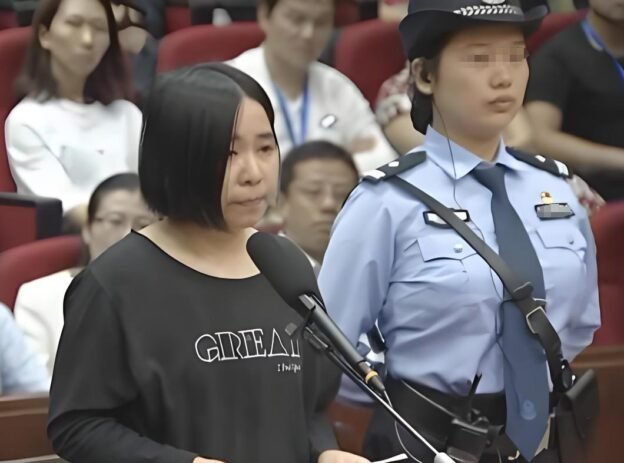
The Hangzhou Intermediate People’s Court found at first instance that: in order to continue raising gambling funds, Mo Huanjing deliberately set fire inside a high-rise residence by starting a fire and then attempting to put it out, in order to win Zhu Xiaozhen’s gratitude and borrow money again, causing four deaths and major property losses; her act constituted the crime of arson; during her employment as a live-in nanny, she repeatedly stole employer property, and the amount was huge, constituting the crime of theft.
Judgment: For arson, Mo Huanjing was sentenced to death with deprivation of political rights for life; for theft, she was sentenced to five years’ imprisonment and a fine of 10,000 yuan; the punishments for the two crimes were combined, and it was decided to execute the death penalty, deprive her of political rights for life, and impose a fine of 10,000 yuan.
Mo Huanjing refused to accept the judgment and appealed.
Second Instance (June 4, 2018)
The Zhejiang Provincial Higher People’s Court held at second instance that: Mo Huanjing deliberately set fire inside a high-rise residence, causing four deaths and major property losses; the criminal motive was vile, the subjective malice was deep, the personal dangerousness was great, the consequences were extremely serious, and the act seriously endangered public safety and caused extremely great social harm; there was insufficient basis for imposing a lighter punishment. The reasons for a lighter punishment raised by her defender were insufficient and were not adopted.
Ruling: The appeal was rejected and the original judgment upheld, and the case was submitted to the Supreme People’s Court for approval of the death penalty in accordance with law.
Execution of the Death Penalty (September 21, 2018)
Upon review, the Supreme People’s Court ruled in accordance with law to approve the death penalty for Mo Huanjing. On the morning of September 21, 2018, the Hangzhou Intermediate People’s Court, in accordance with the execution order signed by the President of the Supreme People’s Court, executed Mo Huanjing. Before execution, the court notified her close relatives that they could meet her, and her close relatives explicitly stated that they would not meet her.
VII. Key Contested Issues in the Case
At second instance, the defense raised two claims that might affect sentencing, both of which were rejected by the court:
First, whether Mo Huanjing constituted voluntary surrender. The second-instance court held that Mo Huanjing had no subjective intention to surrender and was not waiting at the scene to surrender, so she did not constitute voluntary surrender for the crime of arson.
Second, whether defects in the property management’s fire protection could reduce Mo Huanjing’s criminal responsibility. The second-instance court pointed out that the residential compound’s property management did indeed have problems such as inadequate implementation of fire safety management and insufficient emergency response capacity. However, the court held that the deficiencies in property management were a state that already existed before Mo Huanjing committed arson, rather than an external intervening factor after she committed arson, and there was no multiple causation in the criminal-law sense between them and the harmful consequences of this case; therefore, they could not become a statutory reason for reducing responsibility for arson. Mo Huanjing’s act of arson was the sole cause of the consequences in this case.