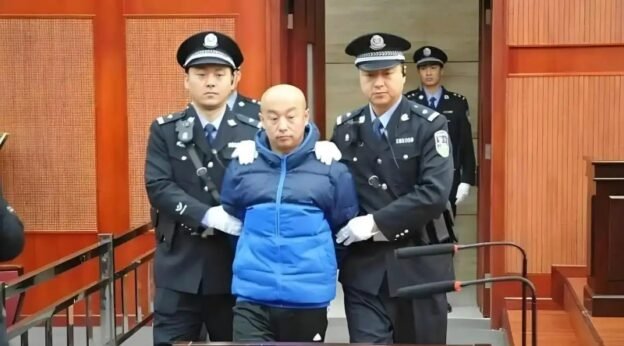
I. Prologue: The Capture of a “Smiling Killer”
On January 2, 2005, in Ulanqab City, Inner Mongolia. A woman surnamed Zhang was raped by a taxi driver while riding in a taxi. She pushed open the door and escaped when the vehicle slowed down, and memorized the license plate number: 蒙JY2230. Police investigation found that the owner of the vehicle was a woman surnamed Chen, but she could no longer be contacted. On the same day, a shepherd discovered a female corpse in a manure pit on the outskirts of the city. The hands and neck were bound with telephone wire, and she had been raped before death. The victim was precisely Chen. DNA identification confirmed that the two cases were committed by the same person.
Thereafter, within fifty days, two more female corpses were discovered on the outskirts of Ulanqab City, and the modus operandi was similar. The Ministry of Public Security listed the case as the No. 2 supervised homicide case of 2005, and an expert group rushed to Inner Mongolia. Based on the description of the sole survivor, a composite sketch was drawn: male, about 27 years old, 1.67 meters tall, thin face, curved eyebrows, triangular eyes.
On October 23, 2005, Zhao Zhihong was captured in Hohhot. He was the person in the sketch. And one thing he voluntarily confessed during interrogation completely changed the nature of this series of cases: he said that the rape and murder case in the women’s restroom next to the dormitory of Hohhot No. 1 Woolen Textile Factory in 1996 was also committed by him.
That case had already been “closed” nine years earlier. The person identified as the murderer was Huugjilt, an 18-year-old who had reported the case, and he had already been executed in June 1996.
II. Zhao Zhihong’s Criminal Facts (the Part Ultimately Confirmed by the Court)
According to the facts confirmed by the Supreme People’s Court in its death penalty review ruling, between September 1996 and July 2005, Zhao Zhihong continuously carried out 17 cases of intentional homicide, rape, robbery, and theft in Hohhot City, Ulanqab City, and other places, killing 6 people in total, forcibly raping 2 underage girls and 10 women, and also committing robbery and theft multiple times.
It should be noted that the criminal facts found by the first- and second-instance courts were 21 cases, causing 10 deaths and the rape of 13 women and underage girls. After review, the Supreme People’s Court did not confirm 4 of them, including the Huugjilt case (the “April 9” female corpse case) that Zhao Zhihong himself admitted. Therefore, the number of deaths ultimately confirmed by the court was 6, not the 10 found by the first and second instances. This discrepancy itself is the core legal issue of this case.
Zhao Zhihong’s modus operandi was highly consistent: he selected women traveling alone as targets, used violence to commit rape, and then killed them to silence them. In some cases, he committed necrophilia after killing. The youngest victim was only 12 years old. In its review ruling, the Supreme People’s Court described him as having “especially vile criminal nature, cruel means, extremely great social harm, and extremely serious consequences and crimes,” and as a recidivist who should be severely punished according to law.
III. Capture and the “Unexpected Confession” (2005)
After Zhao Zhihong was captured, he voluntarily confessed to dozens of cases. The most shocking of these was his confession to the 1996 “April 9” female corpse case. He accurately identified the crime scene, which had long since been demolished and rebuilt, and described the orientation of the restroom—”north-south orientation, women’s restroom in the south”—as well as its internal structure, the victim’s height, the method of strangulation, and other details. According to the recollections of personnel involved in handling the case at the time, Zhao Zhihong’s memory of these details was “clear and certain.”
This confession quickly caused a sensation. The appeal in the Huugjilt case thus gained new momentum. But the problem existed from the very beginning: there were several inconsistencies between Zhao Zhihong’s confession and the original crime scene investigation and autopsy report. These inconsistencies later became the core basis for the court’s refusal to find that he was the true perpetrator in the Huugjilt case.
Another noteworthy detail is that on the night Zhao Zhihong was arrested, Feng Zhiming, an important member of the Huugjilt case task force, upon learning that Zhao Zhihong had confessed to the “April 9” case, violated recusal rules and interrogated Zhao Zhihong alone late at night. This violation was later discovered and stopped by the leaders of the task force, but whether the content of Zhao Zhihong’s statement that night was contaminated became part of the subsequent controversy.
IV. The Long Trial: From the First Hearing to Death Penalty Review (2006–2019)
(I) First Hearing and Adjournment (November 2006)
On November 28, 2006, the Hohhot Intermediate People’s Court held a closed-door trial of the Zhao Zhihong case. A rare scene occurred during the trial: Zhao Zhihong pointed out in court that the prosecution’s indictment had omitted the 1996 rape and murder case (that is, the Huugjilt case), and he admitted that he had done it. The trial was therefore suspended.
After that, the Zhao Zhihong case was never brought to court again. This suspension lasted nine years.
The reason for the stagnation was directly related to the process of correcting the Huugjilt case. Before the Huugjilt case was retried, if the court first found Zhao Zhihong to be the true perpetrator in the Huugjilt case, it would logically directly shake the foundation of the original judgment in the Huugjilt case; but if the court avoided this issue, Zhao Zhihong’s trial could not proceed completely. The two cases fell into a deadlock of waiting for each other.
(II) Retrial of the Huugjilt Case and Restart of the Zhao Zhihong Case (2014)
On December 15, 2014, the Higher People’s Court of Inner Mongolia Autonomous Region announced in a retrial that Huugjilt was innocent. The reason for the retrial judgment was that the original judgment finding Huugjilt guilty of intentional homicide lacked sufficient evidence, and therefore he was declared innocent. The innocence of the Huugjilt case was not because the court found Zhao Zhihong to be the true perpetrator, but because the original evidence itself did not meet the standard.
On the day after the Huugjilt verdict was announced, the Hohhot Municipal People’s Procuratorate announced that it was filing a supplementary prosecution with the Hohhot Intermediate People’s Court regarding the criminal facts of Zhao Zhihong’s involvement in the “April 9” female corpse case, accusing Zhao Zhihong of constituting intentional homicide and rape.
(III) First Instance: Finding That the Huugjilt Case Was Committed by Zhao Zhihong, Death Penalty (January–February 2015)
On January 5, 2015, the Zhao Zhihong case was heard in the Hohhot Intermediate People’s Court, nine years after the previous hearing. At trial, Zhao Zhihong still admitted that he was the true perpetrator of the “April 9” female corpse case. When the presiding judge asked him whether he wanted to defend himself, he said: “I do not want to make any defense for myself, because the crimes I committed are too great.”
On February 9, 2015, the Hohhot Intermediate People’s Court pronounced the first-instance judgment. The court sentenced Zhao Zhihong to death for intentional homicide, rape, robbery, and theft, deprived him of political rights for life, and imposed a fine of 53,000 yuan. The judgment explicitly found that Zhao Zhihong was the true perpetrator of the “Huugjilt case.” The court held that Zhao Zhihong had consistently admitted to this fact, and that there was evidence in the case file such as witness testimony, crime scene investigation records, forensic identification opinions, and video recordings of scene identification, with confession and evidence corroborating each other, which was sufficient to establish the fact.
The first instance found that Zhao Zhihong committed 21 crimes, causing 10 deaths and raping 13 women and underage girls.
(IV) Second Instance: Original Judgment Upheld (April 2015)
Zhao Zhihong appealed. On April 30, 2015, the Higher People’s Court of Inner Mongolia Autonomous Region pronounced the second-instance judgment, rejecting the appeal and upholding the original judgment. The facts found at second instance were basically consistent with those at first instance: 21 crimes, causing 10 deaths, raping 12 women and underage girls (one fewer than at first instance), robbing property worth 31,400 yuan, and stealing property worth more than 3,500 yuan. The Inner Mongolia Higher People’s Court held that Zhao Zhihong’s “criminal motive was vile, the nature especially atrocious, the means especially cruel, and the social harm extremely great,” and that although there were circumstances of confession and partial attempt, they were “not enough to mitigate punishment.”
The case then entered the death penalty review procedure of the Supreme People’s Court.
V. Death Penalty Review: The “Subtraction” Seven Years Later (2019)
From the second-instance judgment in 2015 to the death penalty approval in 2019, another four years passed. Added to the earlier stagnation, nearly fourteen years passed from Zhao Zhihong’s capture to his execution.
In July 2019, the Supreme People’s Court made a death penalty review ruling. This ruling made an important decision that was outside public expectation but within legal logic: it did not confirm 4 of the 21 criminal facts found by the first and second instances, including the Huugjilt case that Zhao Zhihong himself had admitted.
The person in charge of the Fifth Criminal Tribunal of the Supreme People’s Court explained in detail the reasons for not confirming them when answering reporters’ questions. Taking the Huugjilt case (the “April 9” female corpse case) as an example, the main bases for not confirming it included:
First, the shoe print length did not match. There was a relatively large discrepancy between the length of the suspect’s shoe print extracted from the scene and Zhao Zhihong’s foot length.
Second, key details were missing. There were multiple sharp-force wounds on the victim’s face, which Zhao Zhihong had never mentioned. Zhao Zhihong’s confession was completely blank on this prominent detail that should have been remembered.
Third, the confession contained contradictions difficult to explain. Zhao Zhihong’s confession was inconsistent with itself and with other evidence on some important circumstances, and the credibility of his confession could not be confirmed.
Fourth, some physical evidence had lost the conditions for identification or had been lost. Some important physical evidence extracted during investigation could not be identified due to the passage of time, or had been lost, so that the evidence was not undoubted and sufficient, and it could not be concluded that this crime was committed by Zhao Zhihong as the only conclusion.
The Supreme People’s Court also emphasized that the non-confirmation of the 4 criminal facts was “a legal presumption made based on the situation of insufficient evidence, and does not necessarily conform to objective reality.” The reasons for insufficient evidence included both objective factors such as backward investigative technology at the time and the long interval between the crime and its solution, and subjective reasons such as Zhao Zhihong’s possible memory confusion after years of continuous crimes.
In its review ruling, the Supreme People’s Court confirmed 17 criminal facts, causing 6 deaths. The final conviction and sentencing did not change because of the “subtraction”: Zhao Zhihong was still sentenced to death. On July 30, 2019, Zhao Zhihong was executed. Before execution, he refused to meet with close relatives.
VI. Concluding Remarks: The Gap Between “Confession” and “Evidence”
The Zhao Zhihong case has legally concluded. But the questions it leaves behind are more subtle and more worthy of careful examination than those in the Wang Shujin case.
In the Wang Shujin case, the court denied that Wang Shujin was the true perpetrator of the Nie Shubin case on the ground that his confession was inconsistent with the evidence. In the Zhao Zhihong case, the first-instance court found that Zhao Zhihong was the true perpetrator of the Huugjilt case, but the Supreme People’s Court did not confirm it on review. The judicial system of the same country, at different levels and in different cases, gave opposite answers to the question of “whether a confession can establish guilt.”
The explanation of the Supreme People’s Court is clear: determining a crime depends on evidence, not confession. Zhao Zhihong admitted it himself, but the shoe prints did not match, he could not provide key details, and the physical evidence had been lost. Under these conditions, the law cannot make a finding. This logic is the same as the reason for Huugjilt’s acquittal on retrial: if the evidence is insufficient, there can be no conviction. Huugjilt was convicted back then precisely because the court did not adhere to this standard; Zhao Zhihong was not found to be the perpetrator precisely because the court adhered to this standard.
But the gap in this logic is: if Zhao Zhihong was not the true perpetrator of the Huugjilt case, then who was? Is the true perpetrator of the Huugjilt case still at large (or already dead)? The law can refrain from finding someone to be the true perpetrator based on insufficient evidence, but it cannot answer the question “then who was it?” The familiarity with the scene and the memory of details shown in Zhao Zhihong’s confession, and the contradictions pointed out by the court, exist simultaneously. Public confusion stems precisely from this: why is a person who voluntarily confessed and could identify the scene legally “not” the true perpetrator?
Perhaps the true legacy of the Zhao Zhihong case is not whether it solved the whole truth of the Huugjilt case, but that it demonstrated in an extreme way the boundaries of criminal justice: what the judiciary can do is make judgments within the limits permitted by evidence; what it cannot do is enforce heavenly justice on its own when evidence is insufficient. Zhao Zhihong was undoubtedly a criminal whose crimes were heinous, and he died because of the 17 confirmed crimes. But the truth of the 4 unconfirmed crimes—including the Huugjilt case—was left, with his death, in a place beyond the reach of evidence.
Huugjilt was rehabilitated. Zhao Zhihong was executed. Both are dead. And as for what exactly happened in those few minutes in the women’s restroom in the spring of 1996, the law has already given its answer: insufficient evidence, not confirmed. This answer disappoints some people, but it is precisely what Huugjilt did not receive back then.