I. Overview of the Core Facts of the Case
Wu Xieyu, male, born in 1994 in Fuzhou, Fujian, was a student at Peking University’s School of Economics before the incident. The victim, Xie Tianqin, was Wu Xieyu’s mother. During her lifetime, she was a history teacher at the Second Affiliated Middle School of Fuzhou Institute of Education, aged 48 at the time. Her husband (Wu Xieyu’s father) had died of illness several years earlier, after which mother and son lived together.
The court found upon trial: Wu Xieyu, having once entertained suicidal thoughts due to pessimism and world-weariness, came to believe after his father’s death that his mother Xie Tianqin’s life had lost meaning, and therefore in the first half of 2015 formed the intention to kill his mother and purchased the instruments for the crime online. At around 17:00 on July 10, 2015, Wu Xieyu, taking advantage of the moment when Xie Tianqin returned home and was changing her shoes, struck her repeatedly and violently on the head and face with a dumbbell bar, causing her death. Thereafter, Wu Xieyu concealed the truth, fabricated the story that his mother was accompanying him abroad for exchange studies, defrauded relatives and friends of a total of 1.44 million yuan for his own squandering, and purchased more than ten identity cards to conceal his identity. On April 21, 2019, Wu Xieyu was captured at Chongqing Jiangbei Airport.
II. Background and Premeditation Before the Incident
(I) Family Background
Xie Tianqin was a history teacher at the Second Affiliated Middle School of Fuzhou Institute of Education. In the eyes of colleagues and students, she was introverted and friendly, and loved her students dearly. Her husband had died of illness several years before the incident, after which she and her son Wu Xieyu depended on each other. Wu Xieyu had excelled academically since childhood and was later admitted to Peking University’s School of Economics. In the eyes of relatives, friends, and neighbors, he was a child who had been “extremely, extremely, extremely perfect since childhood.”
However, the records left in public reports concerning the internal relationships within this seemingly intact family are extremely limited. The motive for the killing that Wu Xieyu later stated at trial—believing that his mother’s life had lost meaning—became the core basis on which the court determined his subjective state, but public materials lack a systematic reconstruction of how this motive formed and whether there were specific conflicts between mother and son.
(II) Premeditated Acts
The court found that Wu Xieyu formed the intention to kill his mother in the first half of 2015 and began purchasing instruments for the crime online. According to media reports, before returning home at the end of June 2015, Wu Xieyu had already purchased knives, waterproof cloth, plastic sheeting, protective suits, doctor and nurse uniforms, and other items online, including among the knives alone kitchen knives, surgical knives, carving knives, and saw blades.
The shopping records from this stage later became key evidence proving “premeditation.” Judging from the types of items purchased, the scope of Wu Xieyu’s preparations went beyond mere killing tools and covered materials needed for subsequently handling the scene. In May 2015, Wu Xieyu withdrew from courses and moved out of his dormitory on the grounds that something had happened at home—conduct later retrospectively identified as part of the preparation for the crime.
III. The Day of the Incident: July 10, 2015
(I) The Moment of the Killing
At around 17:00 on July 10, 2015, Xie Tianqin returned to her home in the faculty housing of the Second Affiliated Middle School of Fuzhou Institute of Education. According to the court’s findings, Wu Xieyu, taking advantage of the moment when his mother returned home and was changing her shoes, struck her repeatedly and violently on the head and face with a dumbbell bar, causing her death.
Public reports lack further details about the specific process of the killing. The murder weapon, a dumbbell bar, was a common household item and not one of the knives purchased online beforehand. This choice was not explained in detail at trial.
(II) The Ordinary Appearance Before and After the Incident
It is worth noting that in the days before the incident, there were no records of anything unusual in the mother and son’s outward behavior. According to a report by The Beijing News, on July 5, 2015, Xie Tianqin called relatives and said happily that Wu Xieyu had come home for vacation and that in a few days she would take him back to their hometown to visit his grandmother. A neighbor recalled that on the morning of a day in early July, she ran into the mother and son in the corridor; Wu Xieyu proactively greeted her loudly with “Hello, auntie,” and Xie Tianqin said Wu Xieyu had lost weight and worried about what good food to make to nourish him.
The rupture between these everyday details and the murder five days later became one of the starting points for the widespread confusion and discussion the case later aroused. Within the range visible to outsiders, no signal pointed to the impending event.
IV. Handling of the Scene and Concealment After the Crime
(I) Handling of the Corpse
After the killing, Wu Xieyu handled the scene with extreme meticulousness. According to the court’s findings and media reports, he placed a total of 75 layers of covering—including bed sheets and plastic film—over the corpse, and placed activated carbon packets, refrigerator deodorizers, and the like in the gaps to absorb odors. The corpse was left on the bed, and the room was sealed off.
In addition, Wu Xieyu installed cameras and alarms in the home and connected them to a computer to achieve remote monitoring. The purpose of this arrangement was to enable him to check the situation at the crime scene at any time after leaving home and to learn immediately if anyone entered.
(II) The Twenty-Odd Days After the Crime
From the commission of the crime on July 10, 2015, to his departure from Fuzhou on July 31, Wu Xieyu stayed in Fuzhou for more than twenty days. According to media reports, during this period he cleaned and washed the crime scene by day and stayed in a hotel at night. Between July 12 and July 23, he purchased activated carbon, plastic film, wallpaper, vacuum compression bags, and other items dozens of times, continuously perfecting the handling of the scene.
This behavior of remaining near the scene for a long time after the crime and calmly carrying out cleaning and preparations was later cited in the judicial findings as corroboration of his “extremely deep subjective malice” and “utter lack of any intent to confess or repent.”
V. Defrauding Relatives and Friends and Fabricating the False Appearance That His Mother Was Alive
(I) Fabricating the Fact of Going Abroad with a Parent
After the crime, Wu Xieyu began systematically creating the false appearance that his mother was still alive, and on that basis carried out fraud. He falsely told relatives and friends that Xie Tianqin would accompany him to the United States for exchange studies, and defrauded relatives and friends of a total of 1.44 million yuan on the pretexts of living expenses, tuition, and proof of financial capacity.
The fraud was carried out by contacting relatives and friends through mobile phone text messages, QQ, and other means. In the relatives’ and friends’ understanding, Xie Tianqin accompanying her son abroad was a reasonable and support-worthy matter, so the requests for loans did not arouse suspicion.
(II) Forging a Resignation Letter
In August 2015, Wu Xieyu further forged a resignation letter in Xie Tianqin’s name and submitted it to the Second Affiliated Middle School of Fuzhou Institute of Education. According to media reports, he copied words from his mother’s previous letters, cut out the relevant characters, pieced them together, and copied them again to forge a resignation letter with identical handwriting. In October of the same year, the grade director of the grade in which Xie Tianqin taught received a resignation form mailed from Shanghai, and the resignation was subsequently approved.
After the resignation was approved, the school, like the relatives and friends, believed that Xie Tianqin had indeed gone to the United States with her son. After the school term began in September 2015, school leaders mentioned at a general meeting of all teachers that Xie Tianqin had gone to the United States to accompany her son in his studies.
(III) Sustained Pretense
During his flight, Wu Xieyu did not completely cut off contact with acquaintances. On the morning of the Mid-Autumn Festival, September 26, 2015, he had an exchange with a friend, Meng Chuan, saying that he had spent the entire summer vacation in his hometown handling “some unexpected matters” that were rather troublesome and had kept him busy. He also expressed the hope of “clearing up all the troublesome matters before the New Year” so as to have a good New Year.
On October 7, 2015, Wu Xieyu had a phone call with his high school deskmate Wang Huadong, chatting about senior-year life and post-graduation plans, saying that after graduation he planned to go abroad. Wang Huadong noticed nothing unusual at the time. At the end of December 2015, Wu Xieyu appeared at Peking University for the last time; a classmate said he had seen him return to the dormitory to inquire about make-up examinations, after which he vanished.
VI. Discovery of the Case
(I) The Spring Festival Lie and the Police Report
Around February 5, 2016, Wu Xieyu sent a message to his uncle, saying that he and his mother had returned from Boston, USA, and would arrive at the Putian High-Speed Railway Station in Fujian on February 6, hoping that his uncle would pick them up and bring them home for the New Year.
On February 6, the uncle failed to meet them at the Putian High-Speed Railway Station and could not reach Xie Tianqin. Relatives thus became suspicious and reported the matter to the police.
(II) Discovery of the Corpse
On February 14, 2016, Fuzhou police discovered Xie Tianqin’s corpse at her residence. At that point, about seven months had passed since the crime (often expressed in media reports as “218 days”). On the same day, the case was filed and placed under investigation as a major criminal case, and Wu Xieyu was identified as a major suspect.
On March 3, 2016, the Fuzhou police issued a reward notice offering a reward for the capture of Wu Xieyu. Within hours of its release, the notice spread widely on the Internet, and the case thus entered public view.
VII. Three Years on the Run and Capture
(I) The Fugitive Trajectory
After February 2016, Wu Xieyu’s whereabouts were once a mystery. Subsequent reports showed that during his flight he stayed briefly in Shanghai and Shenzhen, and ultimately took a long-distance bus to Chongqing, where he hid for a long time.
While in Chongqing, Wu Xieyu did not choose to live in isolation but hid in the midst of busy urban areas and nightlife venues. According to media reports, he once worked in a bar under the alias “Zhang Weijin” and worked as a “male model.” During his flight, he also spent more than 100,000 yuan on lottery tickets and frequented pornography-related venues multiple times.
(II) Capture
On the evening of April 21, 2019, Wu Xieyu appeared at Chongqing Jiangbei International Airport and was captured by airport public security police. According to media reports, when captured he carried more than 30 identity cards purchased online. These identity documents were precisely the physical evidence corresponding to the crime of “buying and selling identity documents” later found by the court.
From the commission of the crime on July 10, 2015, to his capture on April 21, 2019, Wu Xieyu was at large for a total of about three years and nine months.
VIII. Judicial Proceedings and Judgment Results
On May 27, 2019, Wu Xieyu was approved for arrest by the Jin’an District People’s Procuratorate of Fuzhou on suspicion of intentional homicide, fraud, and buying and selling identity documents.
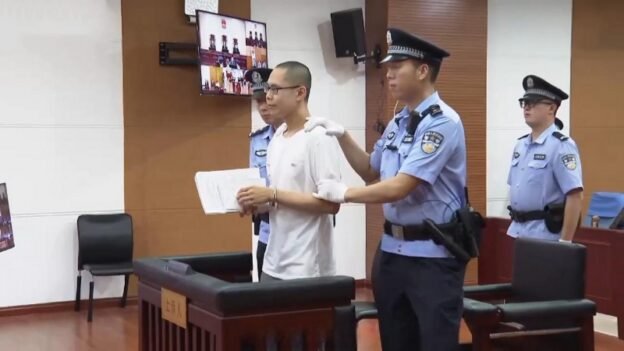
On December 24, 2020, the Fuzhou Intermediate People’s Court held a public first-instance hearing of the case. The procuratorial organ accused Wu Xieyu of the crimes of intentional homicide, fraud, and buying and selling identity documents, and the court announced that judgment would be rendered on a later date.
On August 26, 2021, the Fuzhou Intermediate People’s Court held a public first-instance sentencing. The court sentenced Wu Xieyu to death for intentional homicide, with deprivation of political rights for life; to eleven years’ imprisonment and a fine of 100,000 yuan for fraud; and to three years’ imprisonment and a fine of 3,000 yuan for buying and selling identity documents. Combining the punishments for the multiple crimes, it decided to execute the death penalty, with deprivation of political rights for life, and a fine of 103,000 yuan. The court found that he had “long premeditated and planned to commit the crime of intentional homicide, with extremely deep subjective malice and cruel criminal means,” and that “the act of killing his mother seriously violated family human relations, trampled on the normal emotions of human society, caused extremely vile social impact, and constituted an extremely serious crime.”
Wu Xieyu appealed. On March 21, 2022, the Fujian High People’s Court ruled to suspend the trial due to “reasons of force majeure.” On May 19, 2023, the second-instance hearing was held, and on May 30 a public judgment was pronounced, ruling to reject the appeal, uphold the original judgment, and submit the death sentence ruling to the Supreme People’s Court for approval in accordance with law.
The Supreme People’s Court, upon review, confirmed the facts found in the original judgment, held that Wu Xieyu’s “crime of intentional homicide was cruel in means, vile in circumstances, and extremely serious in nature, seriously violating human ethics and seriously trampling on the cognition and emotions of the public,” and that his “subjective malice was deep and he showed no sincerity of repentance,” and approved the death penalty in accordance with law. On January 31, 2024, the Fuzhou Intermediate People’s Court, in accordance with the execution order issued by the Supreme People’s Court, executed Wu Xieyu. Before execution, the court informed him that he could apply to meet relatives, and Wu Xieyu did not make such an application.