At around 5 a.m. on December 31, 2009, 15-year-old Anhui girl Yu Xiaowei arrived at Wenzhou Railway Station on train K101. More than a year earlier, she had worked at a garment factory in neighboring Wenling City. That summer, Yu Xiaowei had gone to work at a garment factory in Beijing. However, she had only stayed in Beijing for a few months. Because she could not stand the cold of the northern winter, she decided to return to Wenling again. She first needed to take a train from Beijing to Wenzhou, and then take a long-distance bus from Wenzhou to Wenling.
The road in front of the railway station was where taxi drivers solicited passengers. After haggling with a driver over the fare, Yu Xiaowei got into his taxi. Her destination was Wenzhou’s Xincheng Bus Station. After arriving there, she planned to take the earliest bus to Wenling to reunite with her father, who worked there.
The straight-line distance from Wenzhou Railway Station to Xincheng Bus Station was less than 5 kilometers. Under normal circumstances, the drive would not take more than 15 minutes. However, it was not until 40 minutes later that the driver delivered Yu Xiaowei to Xincheng Bus Station. And those 40 minutes were the most desperate 40 minutes in the life of this 15-year-old girl.
After Yu Xiaowei was raped by the man in the same car, he forced her out of the vehicle. She immediately squatted on the ground and cried loudly. A street cleaner discovered Yu Xiaowei and asked her what had happened. She told the cleaner that she had been raped, and the cleaner immediately called the police.
At around 6 a.m. on December 31, 2009, the 110 command center of the Wenzhou Public Security Bureau received a report that a girl from out of town had been raped by a man in the same car while taking a taxi to Xincheng Bus Station.
The police met the victim, Yu Xiaowei, immediately.
According to Yu Xiaowei’s recollection, when she came out of the railway station that day and was preparing to take a taxi, she happened to encounter a taxi driver soliciting passengers. After haggling, the driver agreed that Yu Xiaowei only needed to pay 5 yuan and he would take her to Xincheng Bus Station. Because this driver’s price was lower than the others, Yu Xiaowei thought it was a good deal, so she got into his taxi.
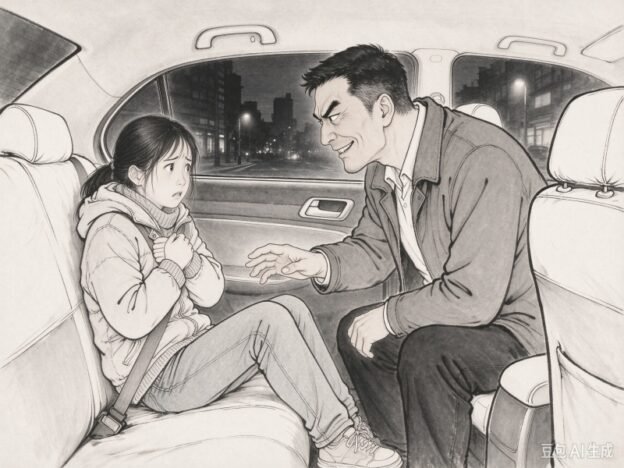
After getting in, Yu Xiaowei discovered that she was not the only passenger in the car. There was also a male passenger in the front passenger seat. Shortly after the car started, the driver stopped and had the male passenger get out from the front passenger seat and sit in the back seat.
Yu Xiaowei’s tragic ordeal occurred precisely after this man sat down in the back seat.
The man tried to strike up a conversation with Yu Xiaowei. At first, he asked her name, how old she was, and where she was from. Later, he asked whether anyone would be picking her up at the station. Yu Xiaowei said no one would be picking her up at the station. The man then revealed his true colors and, with a lewd smile, lunged at Yu Xiaowei.
While struggling, Yu Xiaowei desperately kicked the driver with her feet, hoping to seek help from him.
After the driver discovered Yu Xiaowei’s situation at the time, he once tried to speak up to stop the man, but was verbally threatened by him.
Because the incident occurred in the early morning hours, there were very few vehicles on the streets. During their investigation near the station, the police did not find any witnesses who could provide information. Following the direction of the taxi’s travel as indicated by Yu Xiaowei, the police retrieved surveillance footage from the section of road where the incident occurred, but after careful searching, they did not find any suspicious vehicle.
Because Yu Xiaowei was unfamiliar with the local terrain, the direction of the taxi’s travel that she gave the police was actually wrong. Moreover, because it was early morning at the time of the incident, she had not clearly seen the taxi’s license plate.
There were several thousand taxis in Wenzhou, and most of the drivers were migrant workers with a very high degree of mobility.
Trying to identify among these drivers the one who had carried Yu Xiaowei that day was not easy. While conducting overt and covert inquiries among taxi drivers near the railway station, the police extracted a DNA sample from the criminal suspect and entered it into the Ministry of Public Security’s DNA database for comparison. The police suspected that a criminal suspect who could brazenly sexually assault a passenger in a taxi might well have a criminal record.
Before long, a person named Li Wenchen came into the police’s view. He was from Lankao County, Henan Province, and had come to Wenzhou seven or eight years earlier, where he had worked as a security guard and driven a taxi. DNA comparison showed that the man who raped Yu Xiaowei in the taxi was Li Wenchen.
The Wenzhou police immediately issued a nationwide notice seeking assistance in locating him. In March 2010, the criminal suspect Li Wenchen was arrested by police in Lankao County, Henan Province. Faced with the evidence, Li Wenchen had no choice but to admit to the facts of raping Yu Xiaowei in the taxi.
On April 30, 2010, Li Wenchen was prosecuted by the Lucheng District People’s Procuratorate of Wenzhou on suspicion of rape.
On July 23, 2010, the case of Li Wenchen raping Yu Xiaowei was heard in the Lucheng District People’s Court of Wenzhou. The court found Li Wenchen guilty of rape and sentenced him to seven years and six months in prison.
Li Wenchen was the second child in his family, with an older brother and a younger sister. His parents were honest and ordinary farmers. Several years earlier, Li Wenchen had married, and his son was already 4 years old. According to people from Li Wenchen’s hometown, in the impression of the older generation in the village, Li Wenchen had always behaved well in the village in the past. He was sensible, truly hardworking, and respected the elderly and cared for the young. But after going out to work seven or eight years earlier, he rarely returned home. His family had no idea at all what he did outside or what kinds of people he associated with.
Now that Li Wenchen had been sentenced for rape, his relatives were greatly shocked and found it hard to accept.
During police interrogation, Li Wenchen stated that he did not know the taxi driver and that getting into the taxi was purely accidental. However, this explanation did not convince the police, who felt that Li Wenchen was not telling the truth.
In both Yu Xiaowei’s recollection and Li Wenchen’s account, they both mentioned this detail: the driver did indeed once try to stop Li Wenchen, but after being verbally threatened by Li Wenchen, he chose silence.
At the critical moment when Yu Xiaowei was being violated, the driver was the only person from whom she could seek help. But because of that driver’s indifference and acquiescence, Li Wenchen ultimately succeeded. Why was that driver indifferent to her pleas for help? Yu Xiaowei could not understand it no matter what.
The taxi drivers of Wenzhou were also puzzled and confused by this indifferent driver’s behavior. They believed that at the time Yu Xiaowei was being violated, it would actually have been very easy for the driver to call the police. First, there was a GPS alarm device installed in the car, and the button was right under the dashboard; pressing it was very simple. In addition, the driver could simply dial the three digits 110 on his own mobile phone to report it. If even that was not possible, there were a police station and multiple security booths around the station, and the driver could simply drive there and stop. Finally, there were many taxi drivers waiting for fares around the station, and it would also have been easy for the driver to get out and ask them for help. They truly could not understand why this driver had remained indifferent at the time.
While the police were searching for this taxi driver, some public-spirited Wenzhou citizens also called on everyone to take action to jointly find this indifferent taxi driver suspected of being an accomplice. Some citizens even said they were willing to put up money as a reward for clues about that driver.
Although Li Wenchen claimed that he did not know the driver, the police found such a statement unbelievable. Combined with some details at the time of the incident, they suspected that the taxi driver was not merely indifferent, and that he and Li Wenchen might very well have been in it together from the start, with the driver acting as an accomplice.
Based on Yu Xiaowei’s account, the police believed there were three suspicious points about this indifferent taxi driver: First, the starting fare for taxis in Wenzhou was 10 yuan, so why was that driver willing to take Yu Xiaowei for only 5 yuan? Second, the rapist Li Wenchen had originally been sitting in the front passenger seat, but the driver stopped midway and had Li Wenchen move to the back seat, which provided convenience for Li Wenchen to commit the rape. Third, the indifferent taxi driver did not take Yu Xiaowei directly to Xincheng Bus Station, but instead drove around Wenzhou Railway Station in a big circle, which also provided convenience for Li Wenchen to commit the rape.
Around Li Wenchen’s social relationships in Wenzhou, the police launched a series of overt and covert investigations. In this process, a person named Li Wenkai appeared in the police’s investigative line of sight. Li Wenkai was Li Wenchen’s fellow villager and old acquaintance, and the two had successively driven the same taxi.
According to the victim Yu Xiaowei’s account, Li Wenkai’s physical features were very similar to those of the taxi driver who had carried her that day. According to people with knowledge of the matter, after Li Wenchen was arrested, Li Wenkai behaved very abnormally. He quickly quit his job and then disappeared without a trace.
Over the following period, the police conducted a large amount of investigation and evidence collection around this person Li Wenkai, and ultimately determined that Li Wenkai was the indifferent taxi driver they were looking for.
The police did not find him in Li Wenkai’s hometown, and they searched every possible place where he might stay, but still could not find him. In the end, the police had no choice but to list him as a fugitive online.
On December 27, 2010, nearly a year after the incident, a witness discovered that Li Wenkai had appeared in Wenzhou again.
After receiving the information, the police immediately launched action. That day, the police arrested the criminal suspect Li Wenkai in a rented room in Lucheng District, Wenzhou.
After being arrested, Li Wenkai showed deep remorse: “I now feel especially sorry for that girl, for causing her enormous harm. I do not dare to ask for her forgiveness now. If I could be given another chance, I would risk my life to save her.”
Li Wenkai was 27 years old. In 2004, he came from his hometown in Henan to Wenzhou to work, and had pedaled a tricycle. In 2006, he began driving a taxi in Wenzhou. Because he and Li Wenchen were fellow villagers from the same hometown and had successively driven the same taxi, they had frequent contact with each other.
In the early morning of December 31, 2009, Li Wenkai was soliciting fares near the railway station as usual. At 5:15 a.m., the K101 train from Beijing arrived at the station. At that time, he received a phone call from Li Wenchen. Li Wenchen said he was near the railway station and asked Li Wenkai to take him home, and told him he could pick up another passenger along the way.
Li Wenkai encountered Yu Xiaowei, who was preparing to take a taxi. Because he needed to take Li Wenchen home and was in a hurry to hand over the vehicle at the end of his shift, he decided to take Yu Xiaowei at a cheaper price.
So was Li Wenkai’s having Li Wenchen move to the back seat a coincidence or intentional?
Li Wenkai said that at the time the right front tire was actually leaking air and the car was pulling to the right. After stopping the car, he got out to change the tire. At that moment, Li Wenchen also got out to look. He said it was fine, and anyway the trip was short. Li Wenkai thought about it and felt that probably nothing would happen. Then Li Wenchen said he wanted to sit in the back seat and directly opened the rear door and got in.
When he realized the girl was in danger, Li Wenkai had originally tried to stop Li Wenchen from taking further action, but one sentence from Li Wenchen made him immediately lose his courage.
Li Wenchen said viciously to Li Wenkai: “Do you still want to keep living in Wenzhou?!”
Li Wenkai knew that Li Wenchen had no proper job and spent his days collecting debts for people, fighting, and slashing people. Therefore, out of fear of retaliation, he chose silence.
Out of fear of Li Wenchen, Li Wenkai refused the victim Yu Xiaowei’s plea for help; and also out of fear, when his car was already approaching Xincheng Bus Station, Li Wenkai did not stop, but instead followed Li Wenchen’s direction and began driving in circles around the city.
On May 20, 2011, the Lucheng District People’s Court of Wenzhou heard in closed session the case involving Li Wenkai on suspicion of rape. The court held that Li Wenkai had committed rape and sentenced him to two years in prison.
Li Wenchen deserved his punishment, and Li Wenkai was not worthy of sympathy either. He could have saved a 15-year-old girl with a mere lift of his hand, but instead he chose to be a coward. It is hoped that the victim, Yu Xiaowei, can walk out of the shadows as soon as possible.