I. Prologue: The Odor in Room 317
February 23, 2004, Kunming, early spring. In Room 317 of Building 6 of the Dingxin Student Apartments at Yunnan University, two students pushed open the door and smelled something unusual. Several wardrobes in the dormitory were locked with small plum-blossom-brand padlocks, and liquid with a foul odor was seeping from beneath one of them. They reported it to the duty officer; the security guard came and pried open the wardrobe, and a human foot was exposed.
The police call was made to the Kunming Public Security Bureau at 13:18 that day. After police arrived, they pried open the remaining wardrobes in Room 317. In the four storage cabinets, each hid a male corpse.
Yunnan University had been in session for a week. Five students from the 2000 cohort of the Biotechnology major in the School of Life Sciences had not returned to campus on time to register: Tang Xueli, Yang Kaihong, Shao Ruijie, Gong Bo, and Ma Jiajue. The four corpses were identified by teachers and students as belonging to the first four. The fifth missing person became the major criminal suspect identified by police.
From this moment on, a manhunt lasting more than twenty days, mobilizing a million police officers nationwide, with wanted notices posted in every corner of city and countryside, began.
II. Course of the Incident
(I) Before the Incident: A Crack at the Card Table
Regarding Ma Jiajue’s motive for the killings, the Kunming Intermediate People’s Court later gave a judicial finding in its judgment: in early February 2004, during a card game in the Dingxin Student Apartments at Yunnan University with classmates Tang Xueli, Shao Ruijie, Yang Kaihong, and others, Ma Jiajue had a conflict and thereupon formed the intention to kill Shao Ruijie, Yang Kaihong, and Gong Bo. The court also found that, fearing that his roommate Tang Xueli would obstruct his plan, Ma Jiajue decided to kill Tang Xueli as well.
As to what exactly happened during that card game, public judicial documents and authoritative reports do not provide a word-for-word reconstruction. What can be confirmed is that Ma Jiajue had a dispute with Shao Ruijie and others while playing cards, and the content of the dispute involved evaluations of Ma Jiajue’s character and conduct. The court found that Ma Jiajue “believed that Shao Ruijie, Yang Kaihong, and others said he was a poor person and eccentric in character, and believed that his reputation at school had been slandered,” and that these slanders “were all caused by Shao Ruijie, Yang Kaihong, Gong Bo, and others,” and he “felt very desperate,” and therefore resolved to kill.
This is a psychological chain from “a dispute at the card table” to “a resolve to kill,” and the enormous leap within it later gave rise to countless discussions about Ma Jiajue’s personality and psychological state. The image of Ma Jiajue sketched by police during their visits was: introverted, withdrawn, with a serious inferiority complex, poor at speaking, rarely associating with classmates, fond of going online to view violent, horror, and pornographic images and novels, and rather vindictive. But these descriptions themselves cannot explain how a person went from feeling offended to striking four people to death in succession with a hammer.
(II) Premeditation and Preparation: A Hammer, a Fake ID, and Train Tickets
The court found that after forming the idea of killing, Ma Jiajue “actively made preparations to carry out the crime.”
His preparations included: purchasing a wooden-handled hammer at a second-hand market in Kunming and hiding it in his own wardrobe in Room 317; obtaining a fake identity card under the name “Chen Fenliang” near the North Railway Station; and successively purchasing train tickets from Kunming to Guangzhou and from Kunming to Nanning. Police later disclosed that he had also consulted a large amount of material about other provinces, including national train timetables and transportation maps of Guangxi, Jiangxi, Hainan, Hunan, and other places, and had used others’ identity information to pre-make three fake identity cards.
These preparations pointed to a clear intention: after killing, to flee far away.
(III) Four Days, Four Killings, Four Wardrobes
Ma Jiajue’s crimes spanned February 13 to 15, 2004. Three victims were killed in the same dormitory—Room 317—and the fourth victim was lured to that room and then killed. All four died by the same method: blows to the head with a hammer.
The First: Tang Xueli
At around 23:00 on February 13, Tang Xueli was reading a newspaper in Room 317. While he was off guard, Ma Jiajue took out the previously hidden hammer and struck Tang Xueli on the head from behind, causing his death. Ma Jiajue then took Tang Xueli’s Industrial and Commercial Bank “Lingtong Card,” a Bird mobile phone, and a small amount of cash, hid the corpse in Wardrobe No. 317-4, cleaned the scene, and used transparent adhesive tape to paste newspaper inside the wardrobe to cover the corpse, then locked the cabinet.
Tang Xueli was not originally among those Ma Jiajue planned to kill. The court found that Ma Jiajue decided to kill him as well because he “feared that his roommate Tang Xueli would obstruct his plan.” Tang Xueli appeared in the wrong place at the wrong time.
The Second: Shao Ruijie
At around 23:00 on February 14, Shao Ruijie was washing his feet in Room 317. Ma Jiajue used the same method, striking Shao Ruijie on the head from behind with the hammer, causing his death. He took a small amount of cash Shao Ruijie carried, hid the corpse in Wardrobe No. 317-3, cleaned the scene, and locked the cabinet.
Shao Ruijie was one of the core parties to the dispute at the card game. Among the three people the court found Ma Jiajue resolved to kill, Shao Ruijie ranked first.
The Third: Yang Kaihong
At noon on February 15, Ma Jiajue struck Yang Kaihong on the head from behind with the hammer, causing his death. He took a Siemens mobile phone and a small amount of cash that Yang Kaihong carried, hid the corpse in Wardrobe No. 317-9, cleaned the scene, and locked the cabinet.
Yang Kaihong was likewise a participant in the card-game dispute. In terms of timing, after committing murders on two consecutive nights, Ma Jiajue carried out a third killing in the dormitory at noon on the third day. Whether the other students in Room 317 had by then noticed anything unusual is not mentioned in public reports.
The Fourth: Gong Bo
At around 19:00 on February 15, Ma Jiajue lured Gong Bo to Room 317 under the pretext of “playing cards.” While Gong Bo was reading a newspaper, Ma Jiajue struck him on the head from behind with the hammer, causing his death, took a small amount of cash, hid the corpse in Wardrobe No. 317-2, cleaned the scene, and locked the cabinet.
Gong Bo was the fourth victim and the only one who did not live in Room 317 and was actively enticed to the scene by Ma Jiajue. The court found that he was included on the kill list because Ma Jiajue believed he had also participated in slandering his reputation.
Wrapping Up and Fleeing
After completing the killings, Ma Jiajue threw the two robbed mobile phones into the Panlong River; Tang Xueli’s “Lingtong Card” was swallowed by an ATM when he tried to withdraw money. At around 23:00 on the 15th, he fled Kunming on the pre-purchased Kunming-to-Guangzhou train.
From the evening of the 13th to the evening of the 15th, less than forty-eight hours, four lives. Four wardrobes, four locks.
(IV) Discovery: A Scene Found a Week Late
Ma Jiajue had made ample preparations for the crimes and his escape. Police later noted that before fleeing he “made a series of arrangements to delay discovery and evade capture,” which greatly delayed the discovery of the crime scene and “created enormous difficulty for the arrest work,” showing that he “had a certain anti-investigation capability.”
The odor in Room 317 ultimately exposed everything. On February 23, a week into the school term, the abnormality in the dormitory could no longer be ignored. When the security guard pried open the cabinet and the human foot was exposed, Ma Jiajue had already left Kunming for eight days.
(V) The National Manhunt: A-Level Wanted Notice and the Tip-Off in Sanya
On February 23, the Yunnan Provincial Public Security Department issued a wanted notice across the province overnight. On February 24, the Ministry of Public Security issued an A-level wanted notice nationwide for the arrest of Ma Jiajue, a major murder suspect at large in the “2·23” case.
This was one of the most closely watched public events in China in early 2004. Central leaders gave instructions, and the Ministry of Public Security held two consecutive emergency teleconferences to deploy the manhunt. More than one million public security police officers nationwide acted urgently, conducting strict checks at bus stations, passenger ferry terminals, train stations, airports, hotels, inns, rental housing, internet cafes, electronic game arcades, and other venues. Xinhua News Agency, CCTV, and other media broadcast the wanted notice, and local media at all levels published it. Wanted notices were posted in streets and alleys of cities and villages, and drivers of buses, taxis, and pedicabs were mobilized to assist in the search.
In their analysis, the special task force gradually made Hainan a focus of the search. The possibility that Ma Jiajue was hiding in Sanya became increasingly prominent, and police dispatched personnel directly to Hainan.
At around 7:00 p.m. on March 15, near a river embankment on Hexi Road in Sanya, someone reported to police: a man who closely resembled Ma Jiajue had been spotted. Police quickly arrived and captured the man. Upon preliminary interrogation, the person confessed to the facts of killing four students at Yunnan University. Identification confirmed he was Ma Jiajue.
At this point exactly one month had passed since the incident. Ma Jiajue had mingled among the vagrants and beggars of Sanya, trying to hide himself in the most inconspicuous way possible. But his face, printed on countless wanted notices, ultimately did not escape the eyes of an ordinary person.
In the early hours of March 17, Ma Jiajue was escorted back to Kunming by Yunnan police.
III. The Controversy at Trial: Psychiatric Evaluation and “No Mental Illness”
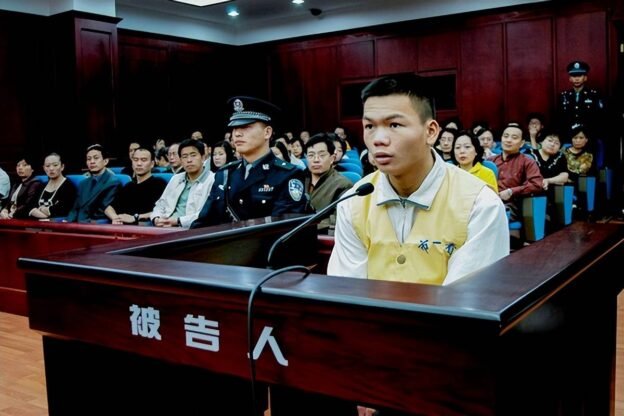
On April 22, 2004, the Kunming Intermediate People’s Court held a public hearing of the Ma Jiajue intentional homicide case. The court appointed two defense lawyers for Ma Jiajue. The audience included the defendant and the victims’ families, representatives of the Yunnan Provincial University Working Committee, some deputies to the Kunming People’s Congress and members of the Kunming CPPCC, and journalists from central and provincial and municipal media, totaling more than 250 people.
Ma Jiajue pleaded guilty to all the charges brought by the procuratorial organ. The criminal facts of the case were themselves almost uncontested—four victims, the same method, concealment of bodies to destroy traces, and flight with a fake ID; the chain of evidence was clear.
The controversy centered on Ma Jiajue’s mental state. The defense requested that the court conduct a psychiatric evaluation of Ma Jiajue. The court produced an evaluation issued by the Yunnan Provincial Center for Mental Disease Identification, with the conclusion that Ma Jiajue had full capacity for criminal responsibility at the time of the crimes and had no mental illness.
The defense raised objections to this evaluation on two grounds: the evaluation took only five days from commission to conclusion; and the evaluation did not reflect the use of modern psychiatric identification methods such as EEG and MRI. This objection prompted discussion in legal circles at the time, but the court ultimately adopted the evaluation conclusion. The court later found in its judgment, on a comprehensive basis, that Ma Jiajue “had a meticulous crime plan, clear steps, and firm criminal intent,” and did not have any statutory circumstances for lighter, reduced, or exempted punishment.
Another mitigating circumstance that was excluded was voluntary surrender. Ma Jiajue was captured, and there was no situation of voluntarily turning himself in.
IV. Judgment Result
On April 24, 2004, the Kunming Intermediate People’s Court rendered the first-instance judgment: the defendant Ma Jiajue was convicted of intentional homicide and sentenced to death, with deprivation of political rights for life; Ma Jiajue was ordered to compensate the plaintiffs in the incidental civil action Li Wenyang and Tang Xianhe 20,000 yuan, Shao Weiqing and Huang Xiemei 20,000 yuan, and Yang Shaoquan and Ma Cunying 20,000 yuan.
After the sentencing, within the statutory period, Ma Jiajue did not appeal. The Kunming Intermediate People’s Court submitted the death sentence to the Yunnan Provincial High People’s Court for approval in accordance with law.
Upon review, the Yunnan Provincial High People’s Court held that Ma Jiajue, “because he could not correctly handle interpersonal relationships and accumulated grievances with classmates over trivial matters, developed the evil intention of revenge killing, and after meticulous planning and preparation, cruelly killed four classmates in succession,” and that “his intent to kill was firm and his methods cruel; after killing he concealed the victims’ bodies and fled out of fear of punishment, and his criminal acts caused extremely great social harm, with particularly vile circumstances and particularly serious consequences.” The defense opinion that Ma Jiajue had a good attitude of confession and showed repentance “was consistent with the facts, but the crime was extremely serious, and no lighter punishment was given.”
On the morning of June 17, 2004, the Kunming Intermediate People’s Court announced the Yunnan Provincial High People’s Court’s death penalty review ruling, approving the death sentence for Ma Jiajue. After the sentencing concluded, Ma Jiajue was immediately taken to the execution ground and executed by lethal injection.
From the first hammer blow on February 13 to the injection on June 17, four months and four days.