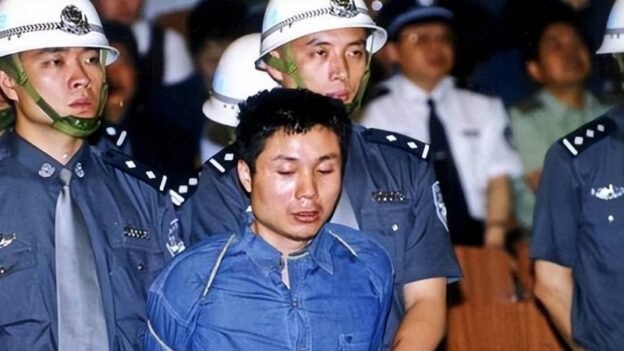
The Yu-Xiang-E Series of Armed Robbery and Murder Cases is an extremely rare violent organized crime case since the founding of New China. The principal offender Zhang Jun and his gang, over a period of nearly ten years, moved across Chongqing, Hunan, Hubei, Yunnan, Guangxi, and other places, committing armed and bladed robberies and murders, and creating a series of bloody cases that shocked the entire nation. It was listed by the Ministry of Public Security as “China’s No. 1 Criminal Case.”
I. The Starting Point of Evil: From Street Thug to Armed Murderer
Zhang Jun was born in 1966 into a poor farming family in Anxiang County, Changde City, Hunan Province. After dropping out of school in the first year of high school, he became a well-known street thug in the local area. In 1983, he was sent to a juvenile correctional facility for fighting. This experience did not set him on the right path; instead, it became an opportunity for him to meet future criminal accomplices. After leaving the juvenile correctional facility, Zhang Jun did not rein himself in but gradually moved toward an even more violent path of crime.
The criminal trajectory of Zhang Jun’s gang can be traced back as early as 1993. According to Zhang Jun’s confession after his capture, in that year he colluded with Liu, whom he had met in the juvenile correctional facility, and, armed with a homemade steel-ball handgun, broke into a grocery store in Anxiang County, Changde City, to commit robbery. When the shop owner, Li (female), saw this and shouted for help, Zhang Jun shot and killed her, but the steel balls also accidentally injured his accomplice Liu in the thigh. During the escape, Zhang Jun, fearing that Liu would expose his whereabouts, unexpectedly smashed Liu to death with an iron hammer and threw the body into a river. This case not only exposed Zhang Jun’s extreme disregard for life but also revealed a core characteristic of his later criminal pattern: he was equally ruthless toward his accomplices, and once he believed the other party might become a burden or threat, he would unhesitatingly eliminate them.
In the years that followed, Zhang Jun did not stop but gradually built a criminal gang with strict organization and clear division of labor. He purchased large quantities of firearms and ammunition through illegal channels, including Type 54 pistols, shotgun hunting guns, hand grenades, and even military hand grenades. Unlike ordinary robbers, Zhang Jun placed great emphasis on the “training” of criminal skills and regularly organized gang members for physical fitness and shooting practice. Even more cold-bloodedly, he required everyone who joined the gang to have blood on their hands as a “pledge of allegiance” to bind them to one another. This “initiation ritual” made it difficult for gang members to turn back once they joined and also made every crime more reckless.
Quan Hongyan’s experience is a typical example of this pattern. In her confession to the police, she stated that in May 2000, under Zhang Jun’s instigation and coercion, she fired a gun and killed someone for the first time. Zhang Jun took her to Changsha and, in a hotel, taught her how to load, disassemble, and insert a magazine into a gun, and also taught her several drawing-and-shooting movements. On the morning of the fourth day, Zhang Jun said to her: “Let’s go. Today I’ll take you to get some blood on your hands.” His tone was relaxed and ordinary, as if they were about to go for a drive. They took a taxi to a grove in the suburbs. Zhang Jun stripped a young man naked, whipped him with branches while reprimanding him for being disobedient, and then handed the pistol to Quan Hongyan, signaling her to shoot. Facing the young man’s pleading look as he turned his head, Quan Hongyan was very frightened and did not dare to shoot, but under Zhang Jun’s urging, she finally closed her eyes and fired twice in succession. Zhang Jun then fired two more shots, and after confirming the person was dead, picked up the shell casings, took the dead man’s clothes, shoes, and socks, and the two took a train back to Chongqing that evening. This confession once again confirmed the facts stated by captured accomplices: Zhang Jun always wanted to turn every member of the gang into a murderer. Only when everyone had a homicide on their record would they gain his trust.
II. Frequent Bloody Cases: Serial Robberies and Murders in Chongqing, Hunan, and Hubei
From the mid-1990s onward, the frequency and violence of Zhang Jun’s gang crimes continued to escalate. They targeted gold shops, bank branches, and cash transport vehicles in bustling areas, choosing to openly carry guns in broad daylight in crowded places, fleeing quickly after success, with the entire process often lasting only one or two minutes. According to the police’s final investigation, from June 1991 to September 2000, Zhang Jun’s gang committed 22 armed and bladed robberies, intentional homicides, and robberies of firearms and ammunition in Chongqing, Hunan, Hubei, and other places, causing 28 deaths, 5 serious injuries, 15 minor injuries, and 2 slight injuries. They robbed property worth RMB 5.369 million, robbed 5 taxis, and robbed 2 micro submachine guns and 20 rounds of ammunition from economic police on duty. Behind these strings of numbers are dozens of shattered families and the fear that countless citizens could not dispel for a long time.
Chongqing: Shadows over the Mountain City
Chongqing was one of the areas where Zhang Jun’s gang was most active. Zhang Jun himself committed a homicide in Chongqing as early as 1993, and for six years afterward, Chongqing police had been tracking him but had never been able to capture him. In Chongqing, Zhang Jun’s gang committed several armed robbery and murder cases that shocked the mountain city. In the gold counter robbery at the Shapingba branch of Chongqing Friendship Store, the gangsters shot and killed 1 person; later, there was also a robbery targeting a commercial bank cash transport vehicle, causing 2 deaths. These cases were carried out cleanly and efficiently, with very few clues left at the scenes, bringing great difficulties to the investigation. On June 19, 1999, another especially serious armed robbery and murder case occurred in Chongqing. Chongqing police quickly visited 11,000 households and screened more than 1.5 million people, and citizens provided 688 clues within just a few days. However, Zhang Jun still disappeared like a ghost into the vast sea of people.
Hunan: The Hometown Became a Bloody Stage
Hunan was Zhang Jun’s hometown and also one of the areas where his gang was most rampant. In the gold counter robbery at Changsha Friendship Shopping Center, the gangsters shot and killed 2 people. The most tragic scene occurred in Changde on September 1, 2000.
At 6:06 p.m. that day, the cash transport vehicle of the Jiangbei Sub-branch of the Agricultural Bank of China in Changde City arrived at the entrance of the North Station Service Office. Three masked gangsters suddenly rushed out from the crowd, shot and killed three economic police officers escorting the vehicle and two cashiers preparing to hand over cash, and seized two micro submachine guns and more than 20 rounds of ammunition. At the same time, another gangster shot and killed a taxi driver nearby. Two female employees of the service office immediately threw themselves to the ground, one sounding the alarm and the other calling the police. In the confusion, the gangsters broke the key off in the rear door of the cash transport vehicle, and the robbery failed. They then jumped into a hijacked taxi and fled. During the escape, they also shot and killed a passing pedestrian, injured three others, and seriously injured a three-year-old girl by hitting her. The entire crime process lasted no more than two minutes, and the cruelty of the methods and the thoroughness of the planning deeply shocked the investigators. Only two minutes after the incident, the “110” of the Changde Public Security Bureau received the report and arrived at the scene within three minutes to begin the pursuit, but the gangsters had already disappeared into the streets and alleys.
This case attracted great attention from the Ministry of Public Security and the party committees and governments of Hunan and Hubei provinces. Hubei mobilized more than 1,000 public security police and armed police officers to set up controls in the Jingzhou area adjacent to Hunan. Forensic experts gathered in Changde and, based on the traces and physical evidence left by the suspects at the scene, successively determined that this case, the August 15 case of killing Hu Menglian, president of the Anxiang County Agricultural Bank in Hunan Province, and his wife Zhang Yuanzhen, and the August 31 case of killing taxi driver Wang Jiyong were committed by the same gang of criminals. It was also linked with the series of especially serious armed robbery cases that had occurred in Chongqing, Changsha, and Wuhan over the past six years for joint investigation.
Hubei: Gunshots at Wuhan Plaza and Key Clues
Wuhan, Hubei, was also an important crime location for Zhang Jun’s gang. In the gold jewelry counter robbery at Wuhan Plaza, the gangsters shot and killed 1 person. Particularly crucial was that, while fleeing after the robbery at Wuhan Plaza, a migrant worker disregarded danger and pointed the way for the pursuing police, and was shot by the gangsters. Liu Guoqin, a photojournalist for Wuhan Evening News, risked his life to capture images of the gangsters fleeing, and in his panic Zhang Jun himself dropped a pistol and other extremely important tools used in the crime. This photograph and the physical evidence left behind later became key clues linking multiple cases and identifying Zhang Jun. Zhang Jun later admitted during interrogation that over the years he had always felt as if he were seeking a living on the tip of a gun, living in constant fear.
III. The Net of Heaven Is Wide: From a Mistress Clue to the Capture of the Demon at Guanyinyan
After the major “9·1” case in Changde, the Ministry of Public Security quickly listed this series of cases as the nation’s No. 1 major case, and the police in Chongqing, Hunan, and Hubei cooperated in operations. Under enormous pressure, Chongqing police kept silent and focused on solving the case, fixing their investigative attention on a woman closely related to Zhang Jun.
This woman was named Yang Mingyan, nicknamed “Juanzi,” then 28 years old. Chongqing police formed a lean and capable major case task force and carried out a large amount of groundwork and investigation. By September 13, the task force began substantive investigation and arrest operations. All vehicles were switched to local license plates and secretly entered Fuling District, where Yang Mingyan lived, and stayed in rooms at the Fuling Hongsheng Resort. For six full days and nights, from Ministry of Public Security officials, the secretary of the Chongqing Municipal Political and Legal Affairs Commission, and the public security bureau chief down to the task force officers, they ate and slept in the rooms and hardly closed their eyes. Because they lost contact with colleagues and family members, during that period they seemed to have “evaporated” from the world.
On September 13, police officers who had been keeping watch outside discovered that Yang Mingyan suddenly left her residence and showed obvious signs of fleeing, and immediately arrested her. According to Yang Mingyan’s account, she had seen Zhang Jun on September 5, and because Zhang Jun was short of money, he sold a blue Santana sedan for 60,000 yuan. This clue suddenly opened up the pursuit that had been silent for many days—Zhang Jun was still in Chongqing and was financially desperate, making it highly likely that he would contact related persons again for money.
At 8 p.m. on September 19, Chongqing police obtained a key piece of information: a Hunan man contacted a woman surnamed Quan and said that at 9 p.m. he would “hand over a package at the place where it rained last time.” After analysis, the police deduced that “the place where it rained” might refer to Guanyinyan or Nanjimen in Yuzhong District, and immediately set up ambushes in both places. Criminal police officer Chen Guo, who participated in the arrest, later recalled that he and his comrades arrived at the Guanyinyan control point at 9:10 p.m. At around 9:20 p.m., a figure appeared in view, looking around and pacing left and right near the alley entrance, and only after carefully observing the surrounding situation did he walk deeper into the alley. At around 9:40 p.m., this person returned to the alley entrance with two bags in his hands. At this time, officers monitoring the woman surnamed Quan sent accurate intelligence: the newcomer was Zhang Jun, and the two bags in his hands were exactly the ones the woman surnamed Quan had just given him.
At about 9:50 p.m., Zhang Jun walked into the ambush zone. He was carrying bags in both hands, and his gun was not in his hands—this was the perfect moment for arrest. Chen Guo exchanged a glance with his comrade, and six officers simultaneously pounced on Zhang Jun, three on each side, respectively grabbing his arms and pressing him to the ground. Chen Guo grabbed Zhang Jun’s right wrist. He later recalled that at the instant they pounced, Zhang Jun had already thrown away the bags and had already drawn the gun with his right hand, but both hands were completely controlled, so the muzzle could only point at the ground and could no longer harm anyone. The entire arrest process was completed in an instant. Police removed Zhang Jun’s left shoe and sock, and a dark mole on the sole of his foot was clearly visible—this was indeed Zhang Jun, who had been pursued for so long.
After being captured, Zhang Jun lamented that he had not expected Chongqing police to be so fast, leaving him “not even a chance to commit suicide.” He also hoped the police would tell his son in his hometown in Hunan to “never do evil, to support himself by his own efforts, and not to pick up even money that others drop on the ground.” At the scene, police seized from Zhang Jun’s person, from the bags handed to him by the woman surnamed Quan, and from related residences 2 Type 54 pistols, 7 instant-action hunting guns, 200 military hand grenades, 200 homemade bombs, 1,949 rounds of various ammunition, and four books on shooting and combat. By the early hours of the next day, police had arrested more than ten criminal suspects involved in the case and seized large numbers of credit cards, securities trading cards, cash, and gold and silver jewelry. The next day, the Ministry of Public Security sent a letter of congratulation to the Chongqing Municipal Public Security Bureau, announcing that the Yu-Xiang-E Series of Armed Robbery and Murder Cases that had shocked the nation had basically been solved.
Before Zhang Jun’s capture, police had already arrested multiple gang members in Yiyang, Changde, and other places in Hunan in early September. On the morning of September 5, the Yiyang Public Security Bureau arrested Zhao Zhenghong, who was preparing to flee, on Xiangcang Road in Ziyang District. It then quickly mobilized 200 public security police and armed police officers to surround and search his rented residence, capturing Li Zejun, who was hiding there, without firing a single shot. In Changde, public security police simultaneously arrested Li Jingsheng, Wang Yu, and Chen Le, and searched a large batch of weapons and ammunition from the home of Zhang Jun’s mistress Chen Le. Zhang Jun’s capture marked the complete destruction of this deeply evil criminal group.
IV. Judgment Results
On April 21, 2001, the No. 1 Intermediate People’s Court of Chongqing Municipality and the Intermediate People’s Court of Changde City, Hunan Province, respectively handed down first-instance judgments on the 18 defendants in this case. Zhang Jun was convicted of robbery, intentional homicide, illegal purchase and sale of firearms and ammunition, and robbery of firearms and ammunition. With multiple crimes punished together, he was sentenced to death, deprived of political rights for life, and had all his personal property confiscated. A total of 14 defendants in the same case, including Li Zejun, Chen Shiqing, Zhao Zhenghong, Yan Ruoming, Xu Jun, Li Jinsheng, Qin Zhibi, Quan Hongyan, Yan Min, Mo Jinying, Nabuo, Zhu Jiawu, and Wang Jun, were sentenced to death; Chen Shixing and Yang Mingyan were sentenced to death with a two-year reprieve; Yang Mingjun and Wang Yu were sentenced to life imprisonment. After the first-instance judgment, 11 people including Li Zejun appealed. The Higher People’s Court of Chongqing Municipality and the Higher People’s Court of Hunan Province respectively made final rulings, rejected the appeals, upheld the original judgments, and legally approved the death sentences. On May 20 of the same year, Zhang Jun and the other 14 criminals were executed in Chongqing and Changde respectively.
From the gunshot in Anxiang County in 1993 to the final capture at Guanyinyan in 2000, Zhang Jun’s gang spent nearly ten years creating a bloody nightmare spanning several provinces. The solving of the case stemmed both from the police’s years of meticulous tracking and decisive closing of the net at the critical moment, and from those ordinary people who, even in fear, still chose to step forward. And Zhang Jun’s final advice to his son before execution—”Never do evil; support yourself by your own efforts”—may have been the only sincere advice in his entire life. It is a pity that he himself never achieved it.