I. Prologue: A Woman Who Had “Died” Eleven Years Earlier
On March 28, 2005, near Hechang Village in Yankou Town, Jingshan County, Hubei Province, a middle-aged woman appeared. Dressed plainly and looking somewhat dazed, she asked people about her family. Someone recognized her, and was immediately shocked to discover—this woman was Zhang Zaiyu. She was the Zhang Zaiyu who, eleven years earlier, had been found “murdered by her husband,” whose body had been discovered in a pond, and whose death had sent She Xianglin to prison.
The news spread like wildfire. Zhang Zaiyu’s family came and confirmed her identity. Where she had been all these years, why she had left no word, and why she had suddenly returned—no one could explain clearly amid the initial confusion. But one thing was certain: she was alive. And the man who had been serving his eleventh year in Shayang Prison for “killing her” was innocent.
From that moment on, the exoneration process in the She Xianglin case was set in motion at unprecedented speed. A criminal judgment that had taken effect seven years earlier, because of the irrefutable fact of the victim’s “resurrection,” moved toward its inevitable end.
II. How the Wrongful Conviction Was Formed (Brief Retrospective)
To understand why exoneration was so difficult and yet ultimately happened, one must first see clearly how this wrongful conviction was manufactured.
(1) The Disappearance and the Unidentified Female Corpse
On January 20, 1994, She Xianglin’s wife, Zhang Zaiyu, went missing. Zhang Zaiyu suffered from mental illness, and both families searched for her in vain. Because there were rumors at the time that She Xianglin had an ambiguous relationship with a young woman, the Zhang family suspected that She Xianglin had killed his wife.
On April 11 of the same year, a female corpse was found in a pond in Lüchong Village, Yankou Town. Zhang Zaiyu’s relatives examined the body and believed the deceased’s characteristics matched Zhang Zaiyu. On that basis, the public security authorities opened an investigation and identified She Xianglin as the suspect. In hindsight, this identification process was the starting point of the entire wrongful conviction: the corpse was highly decomposed, and identification based solely on relatives’ visual recognition should have been questionable under the technical conditions of the time. But no one demanded a DNA test, and no one raised sufficiently forceful doubts about it.
(2) The Confession, the Death Sentence, and Remand for Retrial
After She Xianglin was taken away, the case advanced rapidly. On April 28, 1994, with the approval of the Jingshan County Procuratorate, She Xianglin was arrested. In October of the same year, the former Jingzhou Prefecture Intermediate People’s Court sentenced She Xianglin to death in the first instance. She Xianglin refused to accept the verdict and appealed.
In January 1995, the Hubei Provincial High People’s Court revoked the first-instance judgment and remanded the case for retrial on the grounds that “the facts are unclear and the evidence is insufficient.” This ruling was repeatedly cited in later retrospectives: if the Hubei High Court had not withstood the pressure at that time, She Xianglin would already have been executed, and the “return of the deceased” would have been nothing but an irreparable tragedy. According to a later disclosure by the Hubei High Court’s press spokesman, during the second instance the court came under enormous external pressure—Zhang Zaiyu’s relatives petitioned and organized 220 people to sign a letter demanding She Xianglin’s prompt execution. The Hubei High Court was not swayed by “popular indignation.”
But the remand for retrial did not lead to acquittal. The case circled through the procedures for another three years.
(3) The Fifteen-Year Sentence and the Persecution of Witnesses
On June 15, 1998, the Jingshan County People’s Court sentenced She Xianglin to fifteen years in prison for intentional homicide, with deprivation of political rights for five years. She Xianglin appealed again, and in September of the same year, the Jingmen Intermediate People’s Court ruled to reject the appeal and uphold the original judgment. She Xianglin was sent to Shayang Prison to serve his sentence.
The evidentiary problems in the case file were clearly recorded in the recollections of He Dalin, the defense lawyer in the first instance. After accepting the commission in October 1994 and reviewing the case file, he found that “the only direct evidence in this case was the defendant She Xianglin’s contradictory confessions, sometimes confessing and sometimes retracting; there was little indirect evidence, and it could not form a chain of evidence.” She Xianglin’s confessions regarding the method of the crime had four versions: premeditated murder of his wife so he could remarry; conspiring with another person to kill his wife; his wife having died in a fall and him sinking the body; and not having killed his wife at all. As for the murder weapon, the confessions successively mentioned a wooden club, a stone, and a rope, but there was no physical evidence in the case file corresponding to any of them. The motive alleged in the indictment—premeditated murder of his wife because of an extramarital affair—was also contradicted by the testimony of the so-called “affair partner” Chen, who stated that she and She Xianglin were not in a romantic relationship and that she had no intention of being with him.
But these doubts did not become a force preventing conviction in the judicial process at the time.
She Xianglin’s family also paid a price for petitioning. His mother, Yang Wuxiang, was detained for nine and a half months while seeking justice for her son; she later went blind and deaf, was released after paying three thousand yuan, and died a few months later. His brother She Suolin, who petitioned on his behalf, was detained for forty-one days. The witnesses Ni Xinhai and Nie Maiqing, a married couple who provided a “conscience statement” for She Xianglin, also endured enormous pressure; Nie Maiqing was driven nearly to suicide. A wrongful conviction destroys more than just the person who was wronged.
III. The Exoneration Process: From the “Return of the Deceased” to Acquittal in Court
(1) The First Response: Release on Bail (April 1)
After news of Zhang Zaiyu’s return spread, the Jingmen Intermediate People’s Court urgently revoked the first-instance judgment and the second-instance ruling on March 30 and ordered the Jingshan County People’s Court to retry the case. To avoid She Xianglin continuing to serve his sentence, the court first adopted the method of changing the compulsory measures.
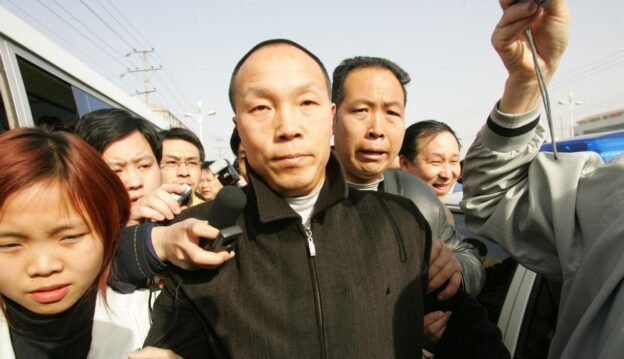
On April 1, 2005, the Jingshan County People’s Court decided to release She Xianglin on bail. At around seven that morning, She Xianglin was released and returned home. At this point only four days had passed since Zhang Zaiyu appeared. In legal procedure, She Xianglin was not yet “innocent”—release on bail was merely a change in compulsory measures, and the case was still awaiting retrial. But for him and his family, walking out of the prison gates for the first time in eleven years did not need legal terminology to define its significance.
During an inspection tour of Jingshan County from April 2 to 4, Jingmen Party secretary Yuan Liangkuan specifically visited She Xianglin’s father, She Shusheng, and expressed an apology. Yuan Liangkuan demanded that “new officials must handle old matters, and must adhere to the principle of correcting errors whenever they are found.” Hubei Provincial Party secretary Yu Zhengsheng also issued instructions on the case, and the Jingmen Municipal Political and Legal Affairs Commission began supervising the correction of the error and the accountability investigation, reporting daily to the Hubei Provincial Political and Legal Affairs Commission. The Hubei Provincial Procuratorate dispatched personnel to Jingshan to investigate dereliction of duty and illegal acts in the She case.
(2) The Retrial: Five Pieces of Evidence and Acquittal in Court (April 13)
At nine in the morning on April 13, 2005, the Jingshan County People’s Court reopened the trial of She Xianglin’s “wife-killing” case.
The core of this trial was not debate but confirmation of an already indisputable fact. The Jingshan County People’s Procuratorate provided the court with five pieces of evidence proving that She Xianglin had not committed intentional homicide, including Zhang Zaiyu’s own testimony and the results of Zhang Zaiyu’s DNA identification. What these pieces of evidence proved was extremely simple: Zhang Zaiyu was alive, therefore She Xianglin had not killed Zhang Zaiyu.
The court announced in court: She Xianglin was not guilty of intentional homicide and was released in court.
From being taken away in April 1994 to walking out of the courtroom on April 13, 2005, She Xianglin had lost eleven years of personal freedom. He was thirty-nine at the time. After the verdict, She Xianglin stated that he would apply to the court for state compensation on a later date. Personnel from the public security, procuratorate, and court departments involved in handling the case at the time had been suspended from duty, and the Jingmen Municipal Political and Legal Affairs Commission organized a working group to review them.
(3) The Conditions That Made Exoneration Possible
The exoneration in the She Xianglin case depended, in form, on an accidental event: the victim came back alive. In law this is known as the “return of the deceased” type of wrongful conviction correction, which, like the “appearance of the real culprit” type, is the most irrefutable and least legally complex path to exoneration. It does not require re-examining the chain of evidence, assessing whether confessions were voluntary, or judging whether witness identifications were reliable—it only requires confirming that the woman standing before them was the person “killed” in the judgment.
But this “luck” is itself a cruel irony. If Zhang Zaiyu had not returned, She Xianglin would have served his full fifteen-year sentence and would still have borne the reputation of a “wife-killer” after release. Those doubts that already existed in the case file—no physical evidence, contradictory and repeated confessions, a murder motive contradicted by witnesses—had never been able to overturn an effective judgment under the premise that “the victim was dead.” The key to exoneration lay not within the legal process but in an external event beyond the process’s control.
This also explains why the discussion triggered by the She Xianglin case after his exoneration went far beyond the individual case. It showed people that a judgment riddled with evidentiary holes could become indestructible because “the victim” could not speak; and its collapse could also be completed overnight because “the victim” suddenly spoke.
IV. The Outcome
On April 13, 2005, the Jingshan County People’s Court issued a retrial judgment: the defendant She Xianglin was innocent and was released in court.
The previous original judgments—the Jingshan County People’s Court’s judgment of June 15, 1998, convicting him of intentional homicide and sentencing him to fifteen years in prison with five years’ deprivation of political rights, and the Jingmen Intermediate People’s Court’s ruling rejecting the appeal and upholding the original judgment—became invalid with the retrial acquittal.
State Compensation
On May 10, 2005, She Xianglin applied to the Jingmen Intermediate People’s Court for state compensation on the grounds of acquittal in the retrial. His initial compensation claims included compensation for mental distress, compensation for restriction of personal freedom, and compensation for physical disability, totaling more than four million yuan.
After negotiation, the Jingmen Intermediate People’s Court and She Xianglin reached a settlement agreement: compensation for restriction of personal freedom of 255,894.47 yuan in accordance with the law; compensation of 1,100 yuan for the burial expenses of the unidentified female corpse paid by She Xianglin’s family (the actual burial expense was 3,600 yuan, minus the 2,500 yuan already paid by the Jingshan County Public Security Bureau). In addition, the Yankou Town People’s Government of Jingshan County provided a one-time subsidy of 200,000 yuan for the She family’s living difficulties. The compensation She Xianglin actually received totaled 256,994.47 yuan, plus the 200,000 yuan living-difficulty subsidy, amounting to more than 450,000 yuan in total.
The Supreme People’s Court later included the She Xianglin case among the typical cases marking the twenty-fifth anniversary of the implementation of the State Compensation Law. The reason for inclusion noted that the case was an early criminal wrongful-conviction state compensation case that attracted widespread public attention; under the framework of the 1994 State Compensation Law then in force, the court took the lead in introducing a negotiation mechanism into state compensation cases, providing a practical example for the 2010 amendment of the State Compensation Law, which introduced the negotiation mechanism and added the system of compensation for mental distress.