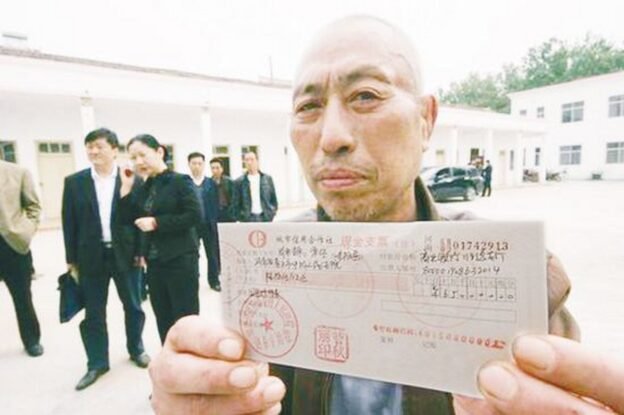
I. Prologue: A Man Who Had “Died” Thirteen Years Ago
On April 30, 2010, a hunched old man appeared at the entrance to Zhaolou Village, Laowangji Township, Zhecheng County, Henan Province. He was hemiplegic, walked with difficulty, and looked down-and-out and exhausted. Some villagers recognized him, and the whole village immediately erupted.
The old man was Zhao Zhenshang. In the collective memory of Zhaolou Village, this man had been “dead” for thirteen years. In 1999, a headless male corpse had been pulled from a motor-pump well in the village, and Zhao Zhenshang’s relatives identified it as him. And the man who had “killed” him—fellow villager Zhao Zuohai—had already served more than ten years in prison.
Village Party secretary Li Zhonghou later recalled the conversation at the time: “I said, where the hell have you been all these years? He said he’d run off to a few places. I said, why did you come back? I said, this is a huge matter for you. And then I said, you died—the whole village knows it.”
Why did Zhao Zhenshang come back? His own account was simple: on the night of October 30, 1997, he had been angry because Zhao Zuohai had gone to Du Moumou’s house, and he had struck Zhao Zuohai on the head with a kitchen cleaver. Afraid of retaliation from Zhao Zuohai, and afraid he might have killed him, he packed up overnight, took four hundred yuan, a quilt, and his ID card, got on his bicycle, and left the village. After that he made a living collecting scrap. In 2009 he suffered hemiplegia, had no money for medical treatment, and only then decided to return to the village.
A man who had fled out of fear returned thirteen years later because of illness and poverty. His return caused a criminal judgment that had already taken effect eight years earlier to collapse completely within nine days.
II. The Original Judgment (Brief)
The starting point of the Zhao Zuohai case was a series of “coincidences.”
On October 30, 1997, Zhao Zhenshang went missing after a conflict with Zhao Zuohai. On February 15, 1998, Zhao Zhenshang’s nephew Zhao Zuoliang reported to the public security authorities that his uncle had been missing for more than four months and that he suspected Zhao Zuohai had killed him. The public security authorities conducted an investigation that year but did not form evidence sufficient to convict.
On May 8, 1999, villagers of Zhaolou Village discovered, while cleaning out a well, a highly decomposed, headless male corpse with the body missing below the knees. The public security authorities immediately treated Zhao Zuohai as a major suspect and placed him under criminal detention the next day.
From May 10 to June 18, Zhao Zuohai made nine incriminating statements. As to how those nine statements were produced, Zhao Zuohai later gave a clear account: torture to extract a confession. His sister Zhao Zuolan relayed his words: “He said he couldn’t take being beaten by them. He said that after they hauled him into the public security bureau, they couldn’t possibly not question him or not interrogate him—they beat him, and he said he did it.” Du Jinmei, who had an ambiguous relationship with Zhao Zuohai, also told the media that she had been forced to admit her relationship with Zhao Zuohai and was required to “confirm” the circumstances of Zhao Zuohai’s killing, and that she had been beaten, including being made to kneel on a wooden stick.
The case was procedurally delayed for more than three years. After Zhao Zuohai had been held for three years and three months, the case was listed by higher-level political and legal authorities as a key case for clearing up prolonged detention, and a prompt conclusion was demanded. On November 11, 2002, the Shangqiu Municipal People’s Procuratorate filed a public prosecution for intentional homicide. On December 5 of the same year, the Shangqiu Intermediate People’s Court issued a first-instance judgment: intentional homicide, sentenced to death with a two-year reprieve, deprived of political rights for life.
From prosecution to judgment, the court took only a little over twenty days to hear the case. A document later made public by the Henan High People’s Court’s Judicial Museum candidly acknowledged the doubts that the presiding judge at the time had already noticed: the headless male corpse could not be conclusively identified as Zhao Zhenshang; two stone rollers had been retrieved from the motor-pump well, and it was unclear how the cement stone roller had been thrown into the well; Zhao Zuohai had stated that he stabbed the victim once in the neck, but the recovered corpse had a sharp-instrument wound on the chest of the torso, contradicting the statement. Yet the court “adopted in full the procuratorate’s opinion, and the procuratorate’s opinion was in fact the public security department’s opinion.” Both Zhao Zuohai and his defense lawyer denied the killing at trial, but the court held that he had made nine homicide statements during the public security stage and that his retraction in court was “not credible.”
Zhao Zuohai did not appeal. On February 13, 2003, the Henan High People’s Court approved the death sentence with reprieve. He was subsequently put in prison to serve his sentence, and during his imprisonment received two sentence reductions, from death with reprieve to life imprisonment, and then to a fixed term of twenty years.
As to why he did not appeal and why he did not petition, Zhao Zuohai’s later explanation was: he had been tortured by the public security authorities, and “was afraid that petitioning would affect his sentence reduction.” This reason itself explains his understanding of his situation—in a system that had already determined he was a criminal, protesting his innocence would only make things worse.
III. The Exoneration Process
(1) The Return of the “Deceased”: Nine Days from Discovery to Release
News of Zhao Zhenshang’s return to the village was transmitted to the judicial authorities within an extremely short time.
Upon learning that Zhao Zhenshang had appeared, the Shangqiu Intermediate People’s Court immediately joined with procuratorial personnel in rushing to Zhaolou Village. Through discussions with village cadres and inquiries of Zhao Zhenshang himself, his sister, and his niece, they confirmed that Zhao Zhenshang was the “victim” in this case. At the same time, Zhao Zhenshang himself stated the reason he had left the village that year: after hacking Zhao Zuohai, he feared retaliation and left overnight, making a living collecting scrap elsewhere, and returned only because hemiplegia and lack of money for treatment left him with no alternative.
On the afternoon of May 5, the Henan High People’s Court listened to the Shangqiu Intermediate Court’s report on the Zhao Zuohai case and decided to initiate retrial proceedings. On the afternoon of May 7, the Shangqiu Intermediate Court submitted evidentiary materials confirming Zhao Zhenshang’s identity. On the afternoon of May 8, Zhang Liyong, president of the Henan High People’s Court, personally presided over a meeting of the adjudication committee, with He Hengyang, deputy procurator-general of the Henan Provincial People’s Procuratorate, attending. The adjudication committee determined that the Zhao Zuohai intentional homicide case was a clear miscarriage of justice.
The adjudication committee made three decisions on the spot: first, to revoke the Henan High People’s Court’s (2003) Yu Fa Xing Yi Fu Zi No. 13 criminal ruling and the Shangqiu Intermediate People’s Court’s (2002) Shang Xing Chu Zi No. 84 criminal judgment, and declare Zhao Zuohai innocent; second, to prepare the legal documents overnight, dispatch personnel to serve them immediately, and contact the prison administration to release him; third, to arrange for Zhao Zuohai’s life after release and initiate the state compensation procedure.
From Zhao Zhenshang’s return to the village on April 30 to the adjudication committee’s innocence decision on May 8, only nine days passed. Compared with the She Xianglin case, in which four days passed from the “return of the deceased” to release on bail and another twelve days to acquittal in court, the correction of the Zhao Zuohai case was faster and more decisive—there was no transitional release on bail, but a direct revocation of the original judgment and a declaration of innocence.
On the morning of May 9, 2010, the Henan High People’s Court held a press conference to inform the public of the retrial and formally declared Zhao Zuohai innocent. Zhao Zuohai was released that day.
(2) The Conditions That Made Exoneration Possible
As with the She Xianglin case, the exoneration in the Zhao Zuohai case depended on an external event that could not be controlled by procedure: the person identified as the “victim” came back alive. In legal terms this is the most irrefutable path to correction—there is no need to re-examine whether the confessions were voluntary, no need to assess whether the chain of evidence was complete; one need only confirm that the hemiplegic old man standing at the village entrance was the person “killed” in the judgment.
But what is special about the Zhao Zuohai case is that the doubts in the original trial were not unseen. The Henan High People’s Court’s own judicial museum record explicitly noted the contradictions the presiding judge had noticed at the time: the identity of the corpse could not be confirmed, the details of the crime did not match the confession, and the defendant had retracted his confession at trial. These doubts did not prevent conviction in the judicial process from 1999 to 2002, nor did they prevent approval in the death sentence review in 2003. They were recorded in the case file and then shelved.
Until Zhao Zhenshang came back.
(3) Accountability and Apology
Simultaneously with the declaration of innocence, the Henan High People’s Court activated its accountability mechanism. The provincial court’s discipline inspection group and supervision office opened an investigation and pursued responsibility against the negligent judicial personnel. The Shangqiu procuratorial authorities subsequently established a sixteen-member review team led by the discipline inspection commission to investigate and pursue those responsible in the Zhao Zuohai case, and took criminal detention measures against three public security personnel suspected of torture to extract confessions.
Apologies and aftercare unfolded almost simultaneously. A vice president of the Shangqiu Intermediate People’s Court went to Zhao Zuohai’s home, handed over an envelope containing five thousand yuan, and bowed deeply at ninety degrees. The Party secretary of Laowangji Township brought one thousand yuan for living expenses and sent a construction team to help Zhao Zuohai build a new house. Zhang Liyong, president of the Henan High People’s Court, later mentioned the case on multiple occasions, candidly acknowledging “the predicament the court’s wrongful conviction brought to Zhao Zuohai,” and led the provincial and municipal court leadership teams to bow and apologize to him.
On June 2, 2010, the Party group of the Henan High People’s Court decided: to designate May 9, the day Zhao Zuohai was acquitted and released, as “Wrongful Conviction Warning Day” for courts throughout the province. Thereafter, on that day each year, the Henan court system would organize discussions and reflection activities, using the Zhao Zuohai case to discuss how to prevent wrongful convictions. Zhang Liyong’s explanation was: “Usually people are unwilling to mention wrongful convictions, but the heavier it is, the more we must learn from the pain and warn our judges to be prudent and cautious.”
IV. The Outcome
Retrial Judgment
On May 8, 2010, the adjudication committee of the Henan High People’s Court decided: to revoke the court’s (2003) Yu Fa Xing Yi Fu Zi No. 13 criminal ruling and the Shangqiu Intermediate People’s Court’s (2002) Shang Xing Chu Zi No. 84 criminal judgment, and declare Zhao Zuohai innocent. On May 9, the judgment was served and executed, and Zhao Zuohai was released.
State Compensation
On May 13, 2010, the Henan High People’s Court held a press conference and announced: Zhao Zuohai would receive state compensation and living-difficulty subsidies totaling 650,000 yuan, of which 500,000 yuan was state compensation and 150,000 yuan was living-difficulty subsidy.
The Zhao Zuohai case was later included by the Supreme People’s Court among the typical cases marking the twenty-fifth anniversary of the implementation of the State Compensation Law.
V. Epilogue: Between Symbol and Old Farmer
Zhao Zuohai died on March 24, 2025, at the age of seventy-three. Twenty-one tables of people came to his funeral; of his four children, only the eldest son and his daughter returned to the village to wear mourning attire.
He was fifty-eight when he gained his freedom and received 650,000 yuan in compensation, which “was perhaps the largest sum of money he had ever possessed in his life.” But that money did not buy him stability. In the few short years after his release, the compensation money left him in various forms. In 2011, he and his wife Li Sulan became entangled in a pyramid scheme in Helan, Ningxia, and lost tens of thousands of yuan of the state compensation. Sun Xuyang, a former media professional who followed the case for years, assessed it this way: Zhao Zuohai’s value as a public symbol was separated from his daily life; in daily life, “he was just an old farmer who had suddenly come into a windfall.”
Eleven years in prison cut off Zhao Zuohai’s process of socialization. Sun Xuyang said that after his release he did not even know what a mobile phone was, and yet he had come into a large sum of money that he was incapable of managing himself; “all kinds of encounters were almost inevitable.” Later, the Shangqiu Intermediate Court arranged for him to read water meters, for 1,800 yuan a month; the court also arranged for Li Sulan to clean meeting rooms, with the same income. The house they lived in was rented with the court’s help, and water and electricity bills were reimbursed.
The institutional traces the Zhao Zuohai case left in China’s criminal justice history are clear: the establishment of “Wrongful Conviction Warning Day,” the Henan High People’s Court’s demonstration of speed in correcting the error, and the rapid initiation of state compensation procedures under public pressure. But between these institutional “advances” and the more than ten years of Zhao Zuohai’s life after release, there is a gap that is difficult to bridge. The exoneration gave him innocence and a sum of money, but it did not, and could not, give back the eleven years lost after the night of torture, nor a farmer’s ability to start life over at the age of fifty-eight.
His uncle Zhao Zhenju said that Zhao Zuohai rarely returned to the village, going back two or three times a year and staying only a day or two. The last time he returned was in the first month of the 2025 lunar year, when he was already ill; his stomach looked somewhat swollen, but no one knew what the illness was. Two months later, he died in a hospital in Shangqiu and was buried in his family’s wheat field; when he was buried, the wheat shoots had grown to knee height.