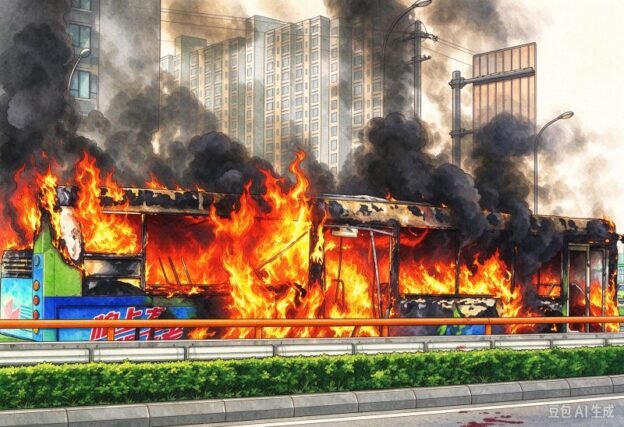
On the evening of June 7, 2013, at 18:22, on a BRT bus rapid transit lane in Xiamen, Fujian Province, a bus suddenly burst into flames. In just over ten minutes, the fire engulfed the entire bus, causing a tragic toll of 47 deaths and 34 injuries. Among the 47 dead were 8 students who were due to sit the college entrance examination the next day.
Xiamen BRT Line 1 runs from Jimei District outside Xiamen Island to the First Pier inside the island. At the time of the accident, it was the evening rush hour, and the bus, with a capacity of 95, was carrying 89 people.
Just 300 meters after the bus passed Jinshan Station, the carriage was shrouded in a sudden burst of white smoke, followed by a rapidly spreading flame. A man in a white shirt was quickly engulfed by the fire.
People on the bus began shouting for the driver to stop. The driver sensed something was wrong and quickly opened the doors. Passengers began evacuating, and some chose to escape by jumping out of the windows.
One passenger who successfully escaped recalled that at Jinshan Station he had smelled a very obvious gasoline odor, and people in the carriage had been discussing who had brought gasoline onto the bus. Just as that was said, a large fire broke out in the middle of the carriage, specifically in the aisle between the priority seats on both sides.
The flames then quickly spread to a man wearing a white shirt, and from there spread throughout the carriage. At that moment, the carriage, with a capacity of 95, was packed with 89 passengers, people pressed against one another with no space to spare, the whole carriage like a can of sardines.
Lin Qiuxia from Zhangpu County was 24 years old at the time. She had received her university diploma from school just three days earlier and had come to Xiamen to work. When the fire broke out she was wearing earphones and listening to music. As the flames spread, she moved slowly with the crowd. Just as Lin Qiuxia ran out of the carriage, the bus exploded, and the entire carriage was engulfed in a sea of fire. In the process, 70 percent of the skin on Lin Qiuxia’s body was burned, with severe burns to her face, back, and arms.
Before the explosion, a college entrance examination candidate, Lin Jiaxin, smashed open a window and jumped out. After getting off the bus, he also pulled a classmate out of the carriage.
The fire burned quickly. In less than ten minutes, the entire carriage was ablaze, and the fire also destroyed seven sections of the barrier fence near the bus.
This section of the BRT bus rapid transit lane is on an elevated bridge, with the bridge deck about ten meters above the ground below. Under the bridge was an auto repair shop. Its owner later said in an interview that at first the white smoke from the bus was not very conspicuous, but it suddenly turned black. People ran off the bus one after another, and then there was a loud bang: the bus had exploded.
The explosion alerted nearby residents, who wanted to rush up onto the bridge to rescue people, but they could not find a way onto the bridge and could only pray quietly below for the safety of those in the vehicle.
About ten minutes after the fire broke out, fire engines arrived, but by then the fire had nearly reduced the bus to an empty shell. By the time the fire was put out, only the frame of the bus remained.
After the incident, a large number of vehicles were stranded on both sides of the elevated bridge, information flow was extremely poor, and the families of passengers on the bus were plunged into anxiety. The situation regarding deaths, injuries, and missing persons was not confirmed until 10 a.m. the next day.
On the night of the incident, a large number of Xiamen citizens who had lost contact with relatives and friends gathered at the First Affiliated Hospital of Xiamen University to confirm whether their loved ones were safe.
One student said that at the time of the incident his classmate was on the bus, and for five hours afterward he was unable to reach the classmate. In the end, the classmate was confirmed to have died in the sudden fire.
On the bus there was also a couple who were preparing to buy a home. They were PhDs from Xiamen University and had stayed on to teach there after graduation. At the time of the incident, they already had a three-month-old baby. They were returning from looking at homes, but in the end they never got to move into a new home.
If not for this accident, the candidate Fu Jiaxin should have been preparing for the college entrance examination the next day with classmates. On the day of the incident, Xiamen traffic police had already tightened security on BRT bus routes, and the traffic police and the bus company jointly opened a green channel for BRT buses. But these measures to safeguard students sitting the college entrance examination did not prevent this tragedy.
Fu Jiaxin suffered second-degree burns and would certainly be unable to take the college entrance examination the next day. Another candidate, Jiang Xiaoting, was also hospitalized for treatment. Tragically, her classmate Yu Ruanqing died in the fire; at the time of the incident, Yu Ruanqing was sitting in the seat behind her.
Police eventually confirmed that there were 15 college entrance examination candidates on the bus, of whom 7 were injured to varying degrees and 8 lost their lives to the fire.
At first, police believed this might have been a case of spontaneous combustion on the bus and quickly took control of the bus driver and the bus dispatcher on duty at the time. All Xiamen BRT buses were suspended from service.
However, after careful investigation, the criminal investigation expert group finally concluded that the fire was not caused by spontaneous combustion, because the entire BRT bus series used diesel engines, the fuel tank was intact, and there were no signs of an oil leak. Test results also showed that the combustion accelerant in the carriage was gasoline. It was clearly a premeditated arson attack on a bus.
Xiamen police immediately set up a special task force to investigate the bus arson case. At the scene, Xiamen police recovered the metal frame of a folding hand-pulled cart, as well as some partially unburned fragments of a woven bag.
Based on this clue, police retrieved the vehicle surveillance footage and surveillance videos from the stops the vehicle passed. The footage showed that at the time of the incident more than a dozen people in the carriage were carrying bags and similar items, but combining this with the metal frame of the hand-pulled cart, police quickly identified a man in a white shirt who was pulling a hand-pulled cart with a bulging woven bag tied to it, containing unknown items.
Through footage from various stops, police successfully identified the community where the suspect lived. With the assistance of community police, they quickly identified the suspect, Chen Shuizong.
Police then seized a suicide note at Chen Shuizong’s home, confirming that he had set the fire out of resentment because he felt his life was unsatisfactory and was pessimistic and weary of the world.
Chen Shuizong’s home is on Jukou Street in Siming District, Xiamen. The area around the street consists of self-built houses, among which are densely packed shops. These shops mainly sell women’s clothing and women’s products, and local people call this area Zhongshan Women’s Street.
Early on the morning of June 8, a large number of police appeared at Chen Shuizong’s home. The narrow passage was crowded with people, and police guarded both sides of the passage.
In the eyes of his neighbors, Chen Shuizong was a clean man. He was taciturn and not eager to interact with neighbors, but the neighbors did not have a bad impression of him.
Chen Shuizong was an old educated youth. He was sent down to the countryside in 1970 and returned to the city in 1983. Perhaps because he had long been unable to integrate into city life, or perhaps because of family poverty, Chen Shuizong never married. It was not until 1994 that Chen Shuizong married and had a child.
Chen Shuizong’s married life was not happy. He had no job and no special skills, so he set up a stall at his doorstep selling snacks. However, for some unknown reason, his snack stall was later shut down.
With no source of income, Chen Shuizong’s life fell into dire straits. Fortunately, his circumstances met the conditions for Xiamen’s minimum living guarantee households, so Chen Shuizong began living on the minimum living allowance.
According to records from the Zhongshan community in Xiamen, starting in 2005 Chen Shuizong received the minimum living allowance for three consecutive years. But by 2009, Chen Shuizong no longer met the conditions for applying for the minimum living allowance, because in November of that year he found a stable job at a property company carrying out old-city redevelopment.
It was precisely because he had a job that his minimum living allowance was canceled.
In February 2013, Chen Shuizong resigned and once again fell into a situation with no source of income. Chen Shuizong began to seek retirement benefits, because Xiamen had introduced a new policy: anyone who had participated in the “sent-down to the countryside” movement and had reached the age of 60, as long as they could provide relevant supporting documents and pay 20,000 yuan in social insurance in a lump sum, could receive a government pension.
According to the information on Chen Shuizong’s household registration booklet and ID card, Chen Shuizong was born in March 1954, less than a year short of age 60 at the time.
But Chen Shuizong believed that the information recorded on these documents was wrong. He believed he was born in 1952, and that when his household registration was transferred years earlier, the police station had filled in his age incorrectly, making the age on his documents two years younger than his actual age. Therefore, he believed his age met the policy requirements.
So Chen Shuizong went to the local police station to request a change to his age, but in the absence of evidence, the police station refused to change it. Frustrated, Chen Shuizong began pinning his hopes on reporting his demands to higher administrative departments. He went successively to the subdistrict office and the public security bureau to report the situation, but was rejected each time.
On June 6, 2013, Chen Shuizong posted 12 complaints on Weibo all at once, claiming that he had been treated unfairly by government departments.
On the afternoon of the day before the incident, Chen Shuizong’s second elder brother saw him. His brother felt that Chen Shuizong was no different from usual, so he left.
In the eyes of his neighbors, Chen Shuizong was a very lonely person. From their windows they often saw him pacing alone in his room. Chen Shuizong was also a hot-tempered person. He had once called the police nine times in a single day to report his neighbors because he found them too noisy and said it affected his rest.
From returning to the city as an educated youth, to failing to find stable work, to having his minimum living allowance canceled, to being refused when seeking to change his age—in Chen Shuizong’s eyes, he was a man abandoned by society. Gradually this mindset evolved from unwillingness into anger, and from anger into revenge, ultimately leading to the arson tragedy that killed 47 and injured 34.