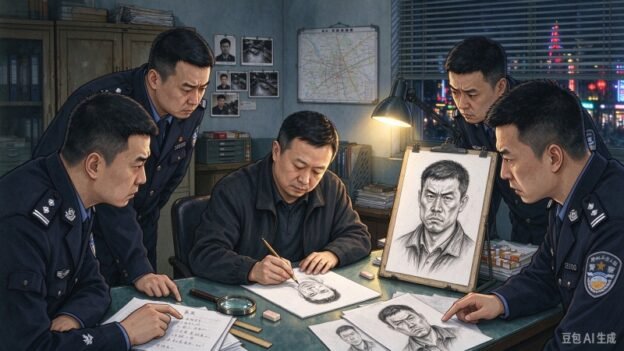
On the morning of October 21, 1997, police in Changzhou City, Jiangsu Province, received a report from employees of Yimin Grocery Store that their two night-shift workers had been killed the previous night.
Upon receiving the report, police immediately rushed to the scene. The scene was extremely bloody. The two victims had been struck on the head with a blunt instrument while asleep and killed. A check by store staff revealed that a large quantity of cigarettes had been stolen.
Of the two deceased, one was Zhu Jumei, a retired female employee who had come to the store for the night shift. The other was Xue Chunfeng, a newly hired 20-year-old female sales clerk who lived at the store at night because her home was relatively far from where she worked.
Through crime scene investigation and taking into account the stolen cigarettes from the store, police quickly determined the nature of the case: it was a homicide that had escalated from theft to robbery and murder.
Based on the crime scene investigation and interviews conducted in the surrounding area, police developed a preliminary profile of the perpetrator: a young adult male, approximately 25 years old, financially strapped and in great need of money; relatively experienced in his methods, likely with a prior record of theft; with a non-local accent, a drifter.
The first 24 hours after a crime are the golden time for solving it. Once this opportunity is missed, the suspect may well have fled far away, making it extremely difficult to find and catch him again.
Given that the perpetrator had stolen a large quantity of cigarettes from the scene, police focused on conducting large-scale, meticulous visits and investigations of tobacco and liquor shops and small convenience stores in the urban area. Sure enough, they found an important lead at a cigarette shop.
The cigarette shop owner told investigators that at around 4 a.m. on the 21st, while still asleep, someone knocked on his door asking whether he bought cigarettes. The shop owner noticed that the cigarettes in the other person’s hands bore the “Changzhou Tobacco Monopoly Bureau” monopoly sticker. This type of cigarette was not yet circulating on the Changzhou market at the time, and combined with the suspicious behavior of the person, the owner suspected the cigarettes were of dubious origin and did not dare to buy them. However, because the impression was strong, he clearly remembered the person’s facial features.
The day after the cigarette shop owner provided the lead to police, police discovered a large quantity of cigarettes stuffed in bags in the Grand Canal that runs through Changzhou. Staff from Yimin Grocery Store identified the cigarettes as the stolen batch. At the same time, the cigarette shop owner confirmed that the cigarettes the person had tried to sell at his shop in the early hours of the previous day were the same batch police had found. This demonstrated that the person who came to the cigarette shop in the early hours of the 21st attempting to peddle cigarettes to the owner was either the perpetrator of the Yimin Grocery Store blood case or his accomplice.
Based on the cigarette shop owner’s description, Changzhou police invited Zhang Xin, a famous forensic sketch artist known as the “Divine Brush Ma Liang,” to render the criminal suspect’s likeness. The brutal suspect finally appeared vividly before the investigators.
The suspect’s appearance had roughly taken shape, but where was he hiding? With the vast sea of people, how could he be captured to comfort the souls of the deceased?
The case was serious. Changzhou police immediately launched comprehensive and meticulous visits and investigations of hotels, guesthouses, shops, rental housing, and gathering places for migrant workers throughout the city. For persons who suddenly left after the crime, police dispatched work teams to various locations to investigate, traveling tens of thousands of kilometers and screening thousands of people. But the true criminal suspect remained hidden in heavy fog, with no trace to be found.
In 1997, when the crime occurred, the internet had only just entered China, DNA databases had not yet been established, and surveillance cameras were far from widespread. Police still relied on traditional investigative methods such as visits and interviews. In addition, the suspect was a drifter who stayed in Changzhou for less than half a day during the crime. So although police poured enormous effort into the case, the investigation encountered tremendous difficulties and had to come to a halt. The killer was not apprehended for a long time.
Although Changzhou police never stopped comparing this case with similar cases and screening for leads, there was never any progress.
In the blink of an eye, 14 years passed. By 2011, the leadership of the Changzhou Public Security Bureau had changed several times, and the officers who had handled the case back then had retired. But this unresolved homicide had always been an knot in their hearts that they could not untie, like a stone pressing on their hearts.
Xue Guowei was the father of victim Xue Chunfeng. When his only daughter was killed at just 20 years old, she had just graduated. If not for that tragedy 14 years ago, Xue Guowei would now be at the age of enjoying his grandchildren. But now all that accompanied him was a broken home and an ailing wife. Whenever he thought of his daughter, what Xue Guowei remembered most was the last time he saw her.
That day, Xue Guowei was alone in his field cutting rice. After finishing, he walked home. When he was almost at the door, he saw his daughter just getting on a bus. She saw him from the bus and waved. He didn’t have time to speak with her, and the next morning his daughter was dead.
After his daughter was killed, Xue Guowei was devastated, crying every day, and never had a happy day again. Xue Guowei’s wife also could not bear the tremendous blow, and her health collapsed. Xue Guowei hid his daughter’s photos and belongings, not daring to let his wife see them.
Xue Guowei always blamed himself for being an unworthy father who had failed to protect his daughter. Self-blame and the pain of losing his daughter were like a thorn, constantly piercing his aged and frail heart.
For taxi driver Zhou Zhedong, the pain of losing his mother was equally agonizing.
The photo Zhou Zhedong took of his mother and daughter on his daughter’s 4th birthday was the last image his mother left in this world. Whenever he missed his mother, Zhou Zhedong would take out the photo and gaze at it. But every time he saw his mother’s photo, Zhou Zhedong would remember the last time he saw her—the most painful memory of his life.
The last time Zhou Zhedong saw his mother was her remains at the funeral home, already prepared for cremation. He wished he could hold his mother’s body tightly and prevent her from being cremated. Zhou Zhedong thought at the time that if he didn’t look at his mother more now, she would soon become a handful of ashes, and he would have no mother anymore.
His mother’s murder not only brought Zhou Zhedong tremendous pain but also caused the entire family to lose all laughter, shrouded in an inexplicable atmosphere of sorrow and fear.
Zhou Zhedong said that his 19-year-old daughter, once it passed six or seven in the evening, would not dare go outside alone without her mother’s company. His daughter had a psychological shadow. Although they lived in the city center, his daughter insisted on having her mother accompany her before she dared go out. It was a deep-seated sense of terror.
Fourteen years had passed, and this bloody case had brought tremendous pain to the families of the two victims. But the suspect’s whereabouts were like a stone sunk in the ocean, with no news at all. Would this cruel killer really be allowed to go unpunished and escape the sanctions of the law?
During the 14 years the suspect was on the run, police investigative approaches, detection methods, and technical conditions all made qualitative leaps forward, making it possible to reinvestigate the case.
In 2011, the Changzhou Public Security Bureau once again established a special task force to investigate this cold case that had remained unsolved for 14 years.
Compared with 14 years earlier, this time police had a new sharp weapon for solving the case: the National Information Database of Offenders and Criminal Suspects.
Changzhou police set several conditions to filter candidates in this database, then organized dozens of officers to compare the filtered individuals one by one against the composite sketch, scoring them by similarity. Finally, they identified 38 individuals with the highest similarity, among whom one named Mo Yang ranked first in similarity.
Mo Yang was 41 years old, a native of Chun’an County, Hangzhou City, Zhejiang Province. He had been detained multiple times for theft. From 1991 to June 1997, he served a sentence at Jinhua Prison in Zhejiang Province. Based on the comprehensive investigation, the task force analyzed that Mo Yang had the time and motive to commit the crime, and his theft methods were similar, making him a major suspect.
On the afternoon of June 27, 2011, with the cooperation of local police, the Changzhou police arrest team that had traveled to Zhejiang successfully captured the criminal suspect Mo Yang and escorted him back to Changzhou overnight.
Facing detectives from the place where the bloody case had occurred 14 years earlier, Mo Yang’s long-held hope of getting away with it collapsed instantly, and he truthfully confessed his crimes.
Mo Yang confessed that in 1997, after being released upon completion of his sentence, he came to Changzhou. Because he was short of money, he sneaked into the Yimin Grocery Store that night intending to steal. Unexpectedly, after entering the store, he found two duty workers sleeping inside. Worried that the noise from stealing would alert them, he grabbed a tool at hand and struck both of them on the head, then swept all the cigarettes from the counter. In the early hours of that day, after the cigarette shop owner refused to buy his stolen goods, he worried about drawing attention to himself, so he threw all the stolen goods into the canal and fled Changzhou.
During the arrest and interrogation, Mo Yang cooperated fully with police and had a good attitude toward confessing. He stated that he pleaded guilty and was willing to pay for his crimes with his life. On the surface, he appeared somewhat dull and inarticulate, seemingly not like a vicious criminal. Why did he embark on such a path of crime?
Mo Yang’s home was an old wooden house near a road in the mountainous area of Chun’an County. Compared with neighboring villagers’ homes, the house looked somewhat old and dilapidated. Mo Yang lived there with his parents and younger brother’s family—three households, eight people in total—in this old house built 20 years earlier. Compared with the new homes of other villagers, it seemed somewhat crowded.
Mo Yang’s elderly father was 77 years old and had originally been a doctor in the city. The family basically lived on the old man’s monthly pension of less than 2,000 yuan. The children usually grew some tea at home and sometimes did odd jobs to supplement the household income, but that money was not even enough to support themselves, and the family’s living expenses were tight and strained. With Mo Yang’s arrest, the family’s situation became even worse.
In the villagers’ impressions, Mo Yang had a good temper and personality and had never quarreled or fought with anyone in the village.
But in his parents’ eyes, Mo Yang was a different image.
Mo Yang’s father said that this son was not filial at all and was rarely seen at home throughout the year. Mo Yang never cared about family matters, only about himself.
Mo Yang’s mother said that Mo Yang had been very obedient when he was little, but changed after he went to health school in his twenties. Her husband disciplined him strictly, scolding him and beating him, telling him not to keep his hair so long. When told to get a haircut, he refused, and her husband beat him with a very thick stick. Mo Yang later ran away from home.
Refusing his strict father’s discipline, running away from home, entering society too early, and acquiring the bad habit of preferring ease and comfort over hard work became the first step on Mo Yang’s path to crime.
Police believed that Hangzhou City in Zhejiang Province was generally a very wealthy place, but Chun’an County, where Mo Yang was from, was a relatively poor area of Hangzhou. So the contrast in what Mo Yang saw was quite large. He saw others were very rich while he himself was impoverished, which created an imbalance in his heart. Combined with his preference for ease over work and his love of gambling, he wanted to steal. If he couldn’t steal, he would become frenzied and start killing. So the root cause of Mo Yang’s extreme turn to murder was ultimately his frenzied pursuit of money.
Mo Yang’s 9-year-old son did not yet know that his father had been taken away by police. He thought his father had left home to work again and was still waiting for his father to come back from work and bring him something tasty. When police asked him about his studies and what songs he had learned to sing at school, unexpectedly, he sang a children’s song familiar to us from childhood: “On the big road, I found a penny, handed it to the policeman’s hand; the policeman said I was a good child, a good obedient child.”
The child is still young and does not understand what has happened around him. We also hope that what happened to his father will not adversely affect the child’s future growth.