On the night of September 27, 2005, a fire quietly ignited in the southern mountainous area of Penglai. In the darkness, two young men threw objects into the flames. On a dark and windy night, what were they burning? Why had they come to this remote area at night to burn things? What secret was hidden in the objects they burned?
I. The Incident: An Old Man Lying on the Road, No Sign of the Hit-and-Run Vehicle
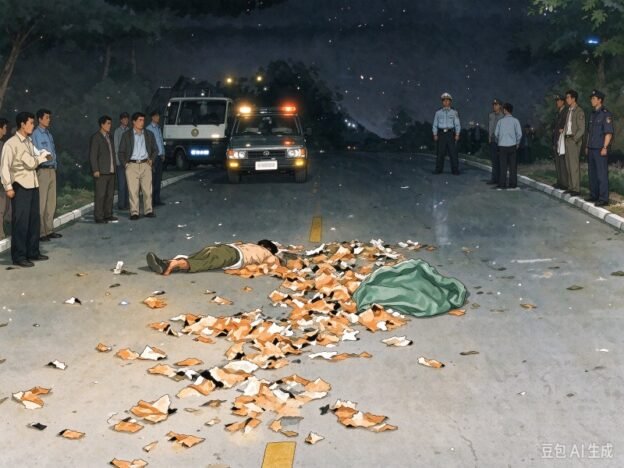
On the evening of September 26, 2005, the Accident Unit of the Traffic Police Brigade of the Penglai Public Security Bureau received a report: a traffic accident had occurred in Cunliji Town, in the southern mountainous area of Penglai. Officers rushed to the scene but found neither the vehicle nor the driver — only the victim lying on the road. The victim was an elderly man, with apple-wrapping paper bags scattered in a fan shape around him — presumably items he had been carrying.
Police confirmed this was a major hit-and-run case. The person who reported the incident had discovered the scene after the fact and had not directly witnessed what happened, so they could not provide the model or license plate of the fleeing vehicle. The hope of solving the case rested on the scene itself — among the scattered paper bags were shards of glass left behind by the vehicle.
II. Identifying the Vehicle Type: From 3,000 to 200
Cunliji Town covers an area of 175 square kilometers, with over 40,000 mu of fertile farmland and over 50,000 mu of mountainous terrain, of which more than 80,000 mu are planted with fruit trees. Thanks to its geographical location and climate, the Yantai apples produced here are renowned worldwide. For agricultural production and transportation needs, nearly every household in the town owns an agricultural vehicle — some families even have three or four.
Technical officers compared and analyzed the glass shards collected from the scene and determined that the vehicle was likely an agricultural vehicle. But there were no fewer than five or six types of agricultural vehicles in the area — which type was it?
After the incident, officers conducted door-to-door inquiries overnight. The accident site was near Denggezhuang Village in Cunliji Town. Although there were homes nearby, residents knew nothing about the accident. It was not until the next morning, when officers expanded the scope of their inquiries, that they finally found an eyewitness. Unfortunately, it was already dark at the time of the incident, there were no streetlights, and the vehicle was traveling very fast, so the witness could not make out the license plate — or even determine whether the vehicle had one at all.
Many local orchardists bought agricultural tricycles mainly for farming and rarely drove them into town, so many did not register their vehicles — making the search for the hit-and-run vehicle very difficult.
Based on the evidence left at the scene and information from the witness, police determined that the vehicle was an agricultural tricycle, narrowing the scope of the investigation. But according to traffic police registration records and preliminary inquiries, there were no fewer than 3,000 agricultural tricycles in Cunliji Town, scattered across 175 square kilometers of countryside — the investigation would not be easy.
Considering that the debris at the scene was scattered in an eastward direction and the victim’s scrape marks also ran from west to east, officers first focused their search on villages east of the scene. At the same time, considering that the vehicle was damaged and the perpetrator would likely have it repaired immediately to cover up the crime, officers also visited vehicle repair shops of all sizes in Cunliji Town. This work went smoothly, but the results were discouraging — no clues to a suspicious vehicle were found.
However, officers conducting the peripheral investigation made a new discovery: the headlight shards left at the scene belonged to a large agricultural tricycle with a driver’s cab. This further narrowed the search. Through villagers, officers learned that this type of cab-equipped tricycle was mainly used locally for selling fruit or for short- and medium-distance transport. Because it was more expensive than ordinary tricycles, few families in the area owned one. Officers reasoned that since these vehicles frequently traveled into town, they should be registered. They then pulled the records of all registered large agricultural tricycles in Cunliji Town — about 200 in total, widely distributed, with some in every village.
The search number had dropped from over 3,000 to 200, and the accident vehicle was clearly damaged — even if the perpetrator had repaired it promptly, careful inspection would reveal traces of the crime. Officers conducting the peripheral investigation were encouraged, but as the search deepened, their spirits soon suffered a setback: a search of villages east of the scene turned up no suspicious vehicles.
According to the initial assessment, the vehicle had been traveling from west to east, and the accident occurred around 6 p.m. — police initially concluded that the perpetrator had been on the way home when the accident happened, meaning the vehicle and its owner should be located east of the scene. But after searching all the villages to the east, no hit-and-run vehicle was found.
III. The Suspicion: Gong Jianxing and the “Lost” Tricycle
After careful analysis, police made a new assessment: the perpetrator might also have been delivering goods from a village to the west to the east, and then returning to a village in the west. Based on this hypothesis, officers launched another round of searches — and this time they had a breakthrough.
While searching Gongjia Village, officers learned from villagers that a resident named Gong Jianxing owned a large cab-equipped tricycle. But when officers visited his home, the vehicle was not there. Gong Jianxing said the vehicle had been stolen — on the very day of the incident. However, although Gong claimed the vehicle was stolen, he had not reported it to police.
Since a coincidence could not be ruled out, officers subsequently visited every village west of the scene and inspected every cab-equipped agricultural tricycle, but found no other suspicious vehicles. Attention once again focused on Gong Jianxing — police suspected he was lying. Gong Jianxing and his mysteriously vanished tricycle became the only point of suspicion in the case. Police formally summoned Gong Jianxing for questioning.
When questioned, Gong Jianxing insisted the tricycle had indeed been stolen. With no evidence to contradict him, officers had no choice but to release him. This was the day after the incident — and that very night, a mysterious fire broke out in a remote mountain hollow in the southern mountains of Penglai.
Police did not give up their investigation of Gong Jianxing. They learned that Gong Jianxing made his living transporting fruit and owned two agricultural tricycles — a new one with a cab and an old one without. He regularly drove his tricycle to markets to sell fruit and sometimes hauled goods to cold storage facilities. On the day of the incident, someone had seen Gong Jianxing driving the tricycle he later claimed was “lost.”
With this new lead, Penglai police summoned Gong Jianxing again — his second summons. Confronted with the witness’s testimony, Gong remained calm. He did not deny driving the “lost” tricycle that morning, but claimed it was stolen that afternoon. According to his account, he had no time to commit the crime — and the witness could not specify exactly when they had seen him driving the tricycle. The second summons thus stalled once again.
Officers pursued the new lead. Someone reported that on the afternoon of the incident, a person had helped Gong Jianxing load and unload his tricycle — but that person had since left the area. To get to the bottom of things, Penglai police conducted multiple searches and traveled thousands of miles to find this witness. The witness said that Gong Jianxing had two tricycles, one new and one old, but could not remember whether they had loaded apples onto the new one or the old one. The witness had seen only one vehicle and loaded only one — not both.
The long journey yielded no definitive answer, and officers began to wonder whether they had the wrong suspect. But with no other leads, they did not give up on Gong Jianxing. They also enlisted several public-spirited residents in Gongjia Village to assist with the investigation.
To get to the truth, Penglai police also used professional equipment to administer a polygraph test to Gong Jianxing. The results indicated that Gong was lying when he said his tricycle had been stolen. However, because the hit-and-run vehicle had still not been found and no effective evidence had been obtained, the polygraph results could only serve as an investigative reference, not as litigation evidence. And so, despite the strong suspicion against Gong Jianxing, police were powerless — the case was left pending for six years.
IV. The Ordeal: Six Years of Waiting for the Victim’s Family
For the victim’s family, those six years were an immense ordeal.
Sun Xintian was the son of the victim in this hit-and-run case from six years earlier. A military veteran, he had been strong-willed since childhood, but since his father’s tragic death, his eyes were often moist. To seek justice for his father, the Sun family had come to the traffic police brigade more than once to urge progress on the case — sometimes voicing complaints in moments of emotional agitation. All officers involved in the case understood the Sun family’s behavior — this was not only the Sun family’s pain but also the pain in the hearts of the investigators.
During the six years of bitter waiting, the Sun family never gave up. They even mobilized the whole family to canvass the area around the scene, searching for leads on the vehicle and driver. Because every trip required passing the spot where his father had been killed, Sun Xintian would take a detour each time — he rejected that painful memory from the bottom of his heart.
V. The Breakthrough: A Casual Conversation at a Gathering
In early January 2011 — the sixth year after the incident — the leadership of the Accident Unit of the Penglai Traffic Police Brigade had changed hands repeatedly, but every successive squadron leader had refused to abandon the case.
During yet another round of visits to Gongjia Village, officers keenly picked up a lead that would lift the veil on this cold case. A villager told police that at a gathering with friends, he had heard someone say that in the autumn of 2005, a man named Gong Pingping had helped a friend dispose of an agricultural tricycle. When this lead came back, police were galvanized: could this be the hit-and-run vehicle?
Once Gong Pingping came into view, police immediately conducted a detailed investigation and found that he was an unemployed man with a criminal record — and, notably, he was related to Gong Jianxing, whom police had long suspected and summoned twice. Moreover, during the period of the incident, Gong Pingping had disposed of an agricultural tricycle. To police, this information was far from simple, and they immediately summoned Gong Pingping for questioning.
After Gong Pingping was brought in, because of his criminal record, his counter-investigation skills were particularly strong. Police worked on him repeatedly, explaining the various stakes involved. Ultimately, Gong Pingping confessed: in the autumn of 2005, he had indeed helped Gong Jianxing drive a hit-and-run vehicle overnight to the nearby city of Zhaoyuan, intending to destroy it completely.
VI. The Arrest: A Fire to Burn the License Plate, a Vehicle Sold for Scrap
Police now believed the time was ripe to arrest Gong Jianxing. On January 7, 2011, the suspect Gong Jianxing was arrested at his home. Confronted with his accomplice’s testimony, Gong Jianxing had no more excuses to make and truthfully confessed what had happened.
It turned out that at the time of the incident, Gong Jianxing was driving his new agricultural tricycle down a steep slope when an oncoming tricycle’s headlights shone so brightly that he could see nothing. Unable to see anything, Gong Jianxing clumsily crashed into the victim. The windshield shattered. He did not brake or stop.
Out of fear, Gong Jianxing did not stop — and precisely because he feared the consequences, he fabricated the story that his vehicle had been stolen. To evade punishment, he did not drive the vehicle home afterward but hid it in a remote mountain hollow. The day after the incident, after police first summoned him, he began to realize how serious the situation was. That very night, after returning home from the traffic police brigade, he and his nephew Gong Pingping drove the hit-and-run vehicle overnight to Zhaoyuan and sold it for scrap. Before that, he had deliberately removed the license plate and burned it on the spot — this was the fire mentioned at the beginning of this article.
Epilogue
After learning that Gong Jianxing had been arrested, the victim’s son Sun Xintian went to his father’s memorial and burned three sticks of incense for him. It was a late consolation.