I. Too Horrible to Look At
At 7:15 a.m. on June 21, 1994, the sun was already as high as a bamboo pole. When a student’s parent was dropping the child off at Mayuanling Primary School, the parent noticed flies and mosquitoes swarming and buzzing under a landscaping tree on the left side of the school gate, and smelled a foul stench. Curious, the parent looked in that direction and saw a pile of broken bones, some still with skin and flesh attached. At first the parent thought residents had dumped pork or beef bones there, but the more the parent looked, the more wrong it seemed. The parent recognized a human skull and half a palm, as well as the long fingernails left on the fingers, and a torso. The limbs had been chopped into sections and cooked. Nearby there was also a bag of clothes… The alarmed parent immediately reported the case to the Changsha Public Security Bureau Beiqu Branch from the reception office of the nearby Hunan Provincial Department of Health.
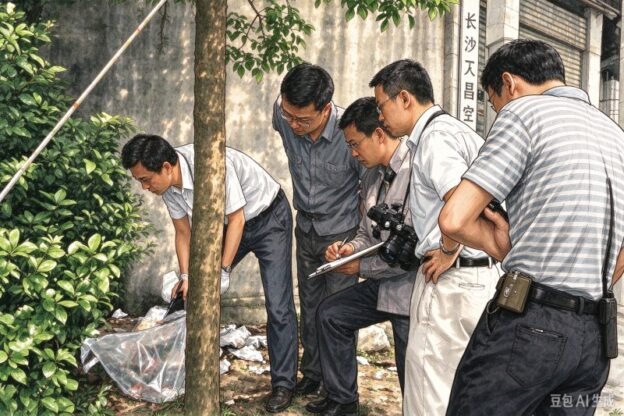
At 7:40 a.m., officers from the Beiqu Branch Criminal Investigation Team, the Beizhan Road Police Station, and the Changsha Public Security Bureau Criminal Investigation Team No. 1, who were conducting flood-control and emergency rescue work in the Beizhan Road area, arrived at the scene one after another upon hearing the news. They pushed through the crowd of onlookers and carried out on-site inspection, sampling, and photography. The dismembered bones, flesh, and clothes were then taken back to the Municipal Public Security Bureau for urgent forensic examination.
Examination established that the deceased was an unidentified young woman, about 21 years old, 1.58 meters tall, with neat white teeth, pierced earlobes, and braided hair. She was wearing a high-grade black low-cut suit dress.
Who was the deceased? A cloud of suspicion hung over people’s hearts.
II. Mother and Daughter Identify the Body
On the day of the case, the “6·21” special task force was quickly established, with Long Jianqiang of the Beiqu Branch as group leader and Wang Juebin, deputy head of the criminal investigation detachment, and Zhang Tiehui, deputy director of the branch, as deputy group leaders.
The elite officers of the task force split into three routes: one route convened meetings of responsible persons and public security officers from all internal units in Beiqu, especially key units, to report the case and seek cooperation; the second route quickly made a mannequin based on the forensic profile of the deceased, dressed it in the deceased’s clothes, and displayed it on a circuit in the Mayuanling area and along Beizhan Road and Furong Road to mobilize citizens to identify it; the third route sent groups down to nearby neighborhood committees to carry out baseline screening together with district police officers.
On the afternoon of June 21, the sun was blazing.
In front of the Hunan Provincial Department of Health guesthouse, a crowd gathered. A fashion mannequin wearing the deceased’s black suit dress and the deceased’s laser Buddha necklace was displayed to passersby, showing the deceased’s former appearance. What people discussed most was the deceased’s high-grade fashion. From her clothing they surmised that the deceased had loved to dress up during her lifetime and might have been a fashionable, glamorous woman.
There was no gain that afternoon.
On June 22, the fashion mannequin wearing the deceased’s clothes appeared again at the intersection near Xiangya Hospital, attracting batch after batch of passersby. Public security officers waited in the blazing sun for an opportunity.
At around 3 p.m., a delicate-looking woman looked at the clothes on the mannequin and turned pale with shock: these clothes seemed to be the ones her older sister had worn. Moreover, her sister had not been home for several days.
The woman immediately rushed home and told her mother what she had seen. The mother was half doubtful and half convinced. After dinner, Changsha Television Station also broadcast a “body identification notice” and showed footage of the clothes the deceased had worn. After watching it, the mother felt something was wrong and, accompanied by her daughter, went to the Beiqu Public Security Branch at 9 p.m. that night.
The mother knew her daughter too well. Based on the texture, style, size, and shape of the buttons of the clothes, she determined that these were the clothes her daughter had worn during her lifetime.
Seeing these things and thinking of the person, the mother wept uncontrollably.
After crying, the poor mother still wanted to see her daughter’s body.
Considering that the deceased had been dismembered and was too horrible to look at, which would be a tremendous shock to the mother, the public security officers said: “The body has already been cremated.”
The mother immediately burst into tears again and murmured: “Just a couple of days ago, she was still such a fine person…”
Later, public security officers obtained the deceased’s fingerprints, hair, and other items from the deceased’s home. After repeated verification and checking, they preliminarily determined that the deceased was Ouyang Quhong, who lived at a certain factory in Changsha. Her father was an associate professor, and her mother was a housewife.
III. The Deceased
Ouyang Quhong, who lived at her parents’ home, was 23 years old and an employee of a state-owned military factory on leave without pay.
It is said that at the tender age of 17, Ouyang Quhong had already lost her virginity to someone, and the pure heart of the young girl was left with a huge trauma ever since. At 18, through an introduction, she married Wang, a volunteer soldier in a certain unit of the navy, but the good times did not last long. Wang died in the line of duty in an accident. Ouyang Quhong was devastated and lamented that her “fate was bad.” Later, the military arranged for her to work at a state-owned military factory. Because the factory’s performance was poor and it was far from home, on July 1 of the previous year she took leave without pay and made a living on her own. She had sold tickets on minibuses, worked as a public relations hostess in dance halls, played video discs in nightclubs, and worked as a hotel waitress…
Having lost her virginity too early, suffered an unfortunate marriage, and lived a life of bright lights and drunken luxury, she seemed to have seen through the fickleness of the world and the coldness of human relationships too early. She no longer cared about anything and thus embarked on a dissolute path in life, pursuing pleasure and excitement. According to people who knew her, during her lifetime she had sexual relations or ambiguous relationships with several men.
IV. Deep Screening and Detailed Elimination
After the deceased’s identity was confirmed, the task force formed two action groups to investigate, through her relatives, the places where Ouyang Quhong had “stayed” and the people with whom she had close contacts.
At 11 p.m. on June 22, the ancient city of Changsha was dimly lit. The raging floodwaters no longer beat so wildly against the embankments of the city moat, and the water level had somewhat receded. At this time, alert investigators discovered Ouyang Quhong’s mysterious rented residence: Door 3, Floor 5, No. 3, Third Lane, Cailuo Middle Road, East District. In her residence, investigators found bloodstains, hair, corpse fluid, fragments of human tissue, and pots and basins used to boil the corpse, and extracted the murderer’s fingerprints. Technical appraisal determined that this was the primary crime scene.
The primary crime scene was neither the deceased’s home nor the murderer’s residence, but a rented house, which brought a certain degree of difficulty to the investigation.
The task force therefore decisively decided: first, to carefully inspect the primary crime scene and collect criminal evidence. The actual tenant of the house was not Ouyang Quhong, but a certain Mr. X, an American citizen of Chinese descent. Mr. X was then far away in the United States, and the possibility of his committing the crime was almost zero. However, it could be proved that Mr. X rented this house entirely to keep Ouyang Quhong as a “canary” for him to enjoy when he returned to China. Second, to investigate from the periphery the people who had ambiguous relationships with Ouyang Quhong or close dealings with her, and to screen and investigate them one by one.
Public security officers conducted investigations one by one into more than 20 “brothers” and “sisters” with whom the deceased had close dealings during her lifetime, and all were ruled out one by one. Mountains and rivers overlapped and no path seemed open; the investigation work almost fell into an impasse.
V. A Glimmer of Hope
Just when one clue after another in the case was cut off, some members of the public reported that Zhao, who worked at a sales outlet of a certain company on Pozi Street in Changsha, had an “unusual” relationship with Ouyang Quhong during her lifetime. Half a month before the case, Zhao’s relationship with Ouyang Quhong had become distant yet close, hot and cold by turns, and he was suspected of committing the crime.
On June 25, public security officers quickly summoned Zhao for questioning. It was verified that he had no time to commit the crime. Apart from admitting that he had “close dealings” with Ouyang Quhong, Zhao also provided an extremely important clue: on June 15, he had gone with Ouyang Quhong to a certain fan factory to see Director Liu Jianguo, and for some unknown reason Ouyang Quhong and Liu Jianguo had quarreled. Afterward, Ouyang Quhong said to Zhao: “I asked you to come with me to the fan factory today because I wanted you to be a witness. If I end up dead, no one will collect my body.”
Who was Liu Jianguo? Public security officers immediately shifted the focus of investigation to Liu Jianguo, director of a certain fan factory.
According to organizational introductions and reports from some workers and staff, Liu Jianguo was then 38 years old and had strong working ability. He had improved the factory’s economic efficiency and had been rated an outstanding Party member and outstanding enterprise manager. But Liu Jianguo was lustful and his lifestyle was undisciplined. He often associated with dubious women, and workers privately called Director Liu Jianguo “Jianguo the Hooligan.”
Meanwhile, officers visiting the primary crime scene learned that on the evening of June 19, in the building opposite the crime scene, a young man, Pu, had vaguely seen a thin, tall man of about 40 busy in the kitchen at the scene. This man’s age and build were similar to Liu Jianguo’s.
A major turning point appeared in the case.
VI. Arresting the Murderer
In the early hours of June 27, the task force decided to immediately summon Liu Jianguo. But Liu Jianguo was not at home. His wife said Liu Jianguo had gone on a business trip elsewhere. Investigators went to the factory to inquire and found that Liu Jianguo had not gone on a business trip at all, but in recent days his movements had been secretive and his whereabouts unknown.
Investigators continued to cleverly visit and maneuver among the workers. One worker provided that Director Liu Jianguo had rented a house in Majiachong, but the exact location was unknown.
On the evening of the 27th, investigators found the Majiachong neighborhood committee. By checking the temporary residence registration, they confirmed that a factory director surnamed Liu rented a place at Door 5, Building 21, East, in the residential area. It was also said that “women of different heights and builds” often came in and out there.
Public security officers immediately decided: set up surveillance.
At 11:30 that night, lights were on on the fifth floor. Inside there were sounds of men and women flirting and music. Investigators pushed bullets into the chamber and shouted loudly at the door: “Director Liu.” The flirting stopped, but the music continued.
They shouted again: “Director Liu.” Still no answer. To prevent Liu Jianguo from jumping off the building, the officers broke down the door. They saw Liu Jianguo hugging a young woman; the woman was so frightened that she screamed loudly. At this time the panic-stricken Liu Jianguo repeatedly said to the several police officers in their twenties: “Uncles, grandpas, what is going on here!”
After technical personnel from the Beiqu Public Security Branch extracted and compared fingerprints, it was determined that Liu Jianguo’s fingerprints matched those left at the murder and dismemberment scene.
That night, technical experts from the Changsha Municipal Public Security Bureau were urgently requested to review and appraise them, and the confirmation was unquestionable.
Ironclad evidence! Liu Jianguo had no choice but to confess the criminal facts: in order to free himself from the entanglement and quarreling of his mistress Ouyang Quhong, he had strangled her to death, dismembered the body, boiled it, and dumped it.
VII. The Truth Comes Out
In May of the previous year, Liu Jianguo met Ouyang Quhong at a certain song and dance hall. Thereafter they had close dealings, and Liu Jianguo even called Ouyang Quhong’s mother “godmother.”
In the summer of the previous year, when Liu Jianguo went on a business trip to Beihai, he carried Ouyang Quhong along behind his wife’s back. The two were inseparable and as intimate as glue, just like a married couple. In the days that followed, the two often had intimate encounters by the river, in parks, and in cinemas.
But Ouyang Quhong was unwilling to live such a sneaky “affair” life for long. She wanted to be Liu Jianguo’s wife openly and properly. Ouyang Quhong knew that Liu Jianguo already had a wife and children, but she did not care. In October of the previous year, Ouyang Quhong proposed “marriage” to Liu Jianguo and demanded that he divorce his wife. Liu Jianguo believed that Ouyang Quhong could be his mistress, but as a wife she was “unreliable,” and he did not agree to her demand.
One day in March, Liu Jianguo took his wife to a nightclub for entertainment, and it happened that Ouyang Quhong was also present. Ouyang Quhong deliberately behaved intimately with Liu Jianguo. Because of this, Liu Jianguo’s wife and Ouyang Quhong quarreled out of jealousy, and they parted unhappily. After that, Ouyang Quhong repeatedly proposed going through “marriage” procedures with Liu Jianguo, but Liu Jianguo did not agree.
To free himself from Ouyang Quhong’s entanglement, Liu Jianguo tried to persuade her with kind words, urging her not to break up his family and saying that other matters could all be arranged. Therefore, Liu Jianguo gave Ouyang Quhong 500 yuan a month for living expenses; in May of this year, Liu Jianguo also gave Ouyang Quhong 6,000 yuan at one time to “do business.”
Ouyang Quhong was not satisfied with these things. On June 15, Ouyang Quhong came again to the fan factory, publicly stated her relationship with Liu Jianguo, and threatened Liu that if he did not agree to marry her, she would make his whole family restless.
On the afternoon of June 19, Liu Jianguo and Ouyang Quhong met as arranged at Wangyue Park on the west bank of the river. This area was precisely the region most severely affected by the flood disaster, and tens of thousands of soldiers and civilians were urgently carrying out flood-control and emergency rescue work. Little did they know that the emotional waves of these two people were also like a bursting dike, impossible to contain. During the three hours in the park, they argued incessantly.
After dinner, Ouyang Quhong told Liu Jianguo that she had another apartment at No. 3, Third Lane, Cai’e Middle Road, and asked Liu Jianguo to go take a look. Liu Jianguo had never known that Ouyang Quhong had another residence, so he went along.
Not long after they sat down, the two again engaged in a fierce verbal battle over the “marriage” issue.
In a fit of anger, Ouyang Quhong placed the razor blade, sleeping pills, and fruit knife she had prepared in front of Liu Jianguo, and desperately threatened him to divorce.
At this time, Ouyang Quhong cut a gash on her own arm with the razor blade, and blood flowed. Liu Jianguo ignored it. Then Ouyang Quhong cut Liu Jianguo’s hands and feet, leaving them dripping with blood. Liu Jianguo endured it and still did not make a sound. Ouyang Quhong pressed further and said: “If you don’t marry me, I will kill your wife and child.”
Recalling Ouyang Quhong’s usual behavior, Liu Jianguo also felt that Ouyang Quhong was “a person who does what she says” and would inevitably do something heinous. Thinking of this, Liu Jianguo was filled with rage. He picked Ouyang Quhong up, pressed her down on the bed, and tightly gripped her neck with both hands… Perhaps only at this moment did Ouyang Quhong, this glamorous woman who pursued pleasure and excitement, suddenly realize that her past life should not have been so absurd and chaotic.
Afterward, Liu Jianguo unhurriedly returned to Majiachong, where another mistress was already waiting for him in the room.
On the morning of the 20th, Liu Jianguo, without changing expression and calm as ever, handled matters related to flood control and disaster relief, then went to the canteen to get a packet of caustic soda and went to the administrative section to collect a bundle of nylon rope and several plastic bags. In the afternoon, Liu Jianguo came to the crime scene to dispose of Ouyang Quhong’s body.
Moving a body alone was too troublesome and easy to notice. Liu Jianguo thought of dismembering the body. He found a kitchen knife in the kitchen, sharpened it, and then cut open the deceased’s body, removed the internal organs, and then chopped the body into chunks and pieces.
Furthermore, Liu Jianguo brought over a liquefied gas stove, placed a large aluminum basin on it, added several buckets of water, poured the dismembered body into the basin, added caustic soda, and boiled it for several rounds before it was cooked. Afterward, Liu Jianguo divided the torso, internal organs, and clothes into several plastic bags, and took off Ouyang Quhong’s gold necklace, two gold rings, and other ornaments.
By after 10 p.m., Liu Jianguo packed the several bags of bones and clothes into a large travel bag, rented a three-wheeled motorcycle, and, taking advantage of the quiet of the night, threw the bones under the landscaping tree beside Mayuanling Primary School.
After that, he took a taxi to Liucheng Bridge and threw the travel bag onto a garbage heap.
By the time he returned home, it was already 11 p.m. Exhausted, Liu Jianguo ate rice soaked in soup, drank liquor, took a shower, and went to bed as if relieved of a heavy burden.
Liu Jianguo believed that there were no documents on the deceased and that the body had been boiled beyond recognition, so he could certainly deceive the world. But he never expected that after only seven days and nights of living in luck, he would be put in shining handcuffs.
What extraordinary seven days and nights. All the public security officers of the task force had reddened eyes, lost several jin of weight, had not taken a decent shower once, and had not slept a full night once.
At this point, the “6·21” especially major murder and dismemberment case had been completely brought to light.
However, what lesson does this case leave for people?
On the road of life there are traps at every turn; life and death, good and evil are in fact only one step apart. People, be vigilant! Do not fail to do good even if it is small, and by all means do not do evil even if it is small. Live cleanly and honestly in this world; this is more important than anything.