I. The Body Parts in the Mountain Hut
On April 19, 2003, in Zherong County, Ningde City, Fujian Province, a tea picker discovered several plastic bags in an abandoned old house on Shilouping Mountain in Fujigang Village, Chengjiao Township. The bags contained dismembered body parts and the victim’s clothing. After the report was filed, police confirmed that the deceased was a woman surnamed Yang (aliases: Yang Yanhui/Yang Hui) from Zherong County, in her twenties, and pregnant.
The dismemberment case quickly shook the small mountain town in northern Fujian. Police turned their investigative attention to the victim’s ex-boyfriend — Miao Xinhua, then 26 years old. According to the “facts” alleged in the indictment and judgment at the time, the incident unfolded as follows: on the evening of April 6, 2003, Yang came to Miao Xinhua’s home. The two argued because Yang’s business of recruiting young women to work elsewhere did not include Miao Xinhua. Miao Xinhua grabbed Yang by the neck and pinned her against the wall by the headboard for about five or six minutes, causing mechanical asphyxiation and death. Miao Xinhua’s father, Miao Deshu, and his second younger brother, Miao Xinrong, heard the commotion and came over. The three agreed to dismember the body. They carried the corpse to the first-floor bathroom and used a kitchen knife, cutting board, and other tools to dismember it. Miao Xinhua’s third younger brother, Miao Xinguang (under 18 at the time of the incident), witnessed the dismemberment, and then at his father’s instruction called their uncle, Miao Jinjia. The five drove a farm tractor and transported the plastic bags containing the body parts to the abandoned house on Shilouping Mountain, where they discarded them.
This narrative would become the shackles placed on the five members of the Miao family for the next fourteen years.
II. From Death Sentence to Suspended Death Sentence: A Conviction Riddled with Holes
In May 2004, the Ningde Intermediate People’s Court held its first trial of the case. According to a Ningde Intermediate Court judge who later spoke to the media, at the first-instance trial all five defendants recanted their confessions in court, claiming they had been subjected to torture to extract confessions, and there was no objective physical evidence directly implicating the defendants. Defense lawyer Wu Jingchu pointed out at the time that the details of several defendants’ statements were highly similar, “with a strong possibility of mutual copying.”
However, after the trial, “supplementary evidence” emerged. Police had extracted “debris” from the bathroom drain at what was identified as the dismemberment scene and sent it for testing, but no results were obtained due to severe contamination of the samples. One year later, police claimed to have found nine hairs in the drain residue, and through mitochondrial DNA testing, three of them were “99.999% likely to be the victim’s hair.”
Just ten days after this appraisal report was issued, the Ningde Intermediate Court rendered its first-instance judgment: Miao Xinhua was convicted of intentional homicide and sentenced to death; Miao Deshu, Miao Xinrong, Miao Jinjia, and Miao Xinguang were convicted of covering up a crime and sentenced to fixed-term imprisonment of 4, 3, 2, and 2 years respectively.
After the defendants appealed, in March 2005, the Fujian Provincial High People’s Court ruled to revoke the original judgment and remand the case for retrial on the grounds that “the original judgment had unclear facts and insufficient evidence.” After retrial, the Ningde Intermediate Court again sentenced Miao Xinhua to death, and all four family members’ sentences were increased: father Miao Deshu to 8 years, second brother Miao Xinrong to 6 years, third brother Miao Xinguang and uncle Miao Jinjia to 3 years each.
After another appeal, in April 2006, the Fujian Provincial High Court commuted Miao Xinhua’s sentence to death with a two-year reprieve, while upholding the increased sentences for the other four. At this point, all five members of the Miao family were imprisoned, and Miao Xinhua, with the longest sentence, began his long prison term.
III. Core Doubts in the Case
The reason this case was overturned years later lies in the fundamental defects of the evidence system upon which the conviction was based. Appeal lawyer Mao Lixin (Beijing Shangquan Law Firm), who took on the case in 2016, identified several key problems after reviewing the case files.
First, no objective physical evidence at any of the three scenes. The second-floor bedroom where the killing allegedly occurred, the first-floor bathroom where the dismemberment allegedly took place, and the abandoned mountain house where the body was allegedly discarded — Mao Lixin pointed out that no fingerprints, footprints, or bloodstains pointing to any of the five defendants were extracted from any of these three scenes. “In a dismemberment case, it’s impossible for such trace evidence not to exist.”
Second, the legality of the confessions is questionable and they are internally contradictory. The case files show that all five defendants initially pleaded not guilty during interrogation, and only began making incriminating statements after April 23, 2003. But these statements were inconsistent, contradictory to each other, and failed to match objective evidence such as the autopsy report. By the review and prosecution stage and at trial, all five recanted, protesting their innocence at both first instance and on appeal.
Third, the scientific validity of the “three hairs” — the only piece of physical evidence — is insufficient. Regarding the mitochondrial DNA appraisal, forensic expert Hu Zhiqiang, who had worked in forensic science for over thirty years, pointed out that mitochondrial DNA testing can only be used for exclusion, not for identification, and cannot support the conclusion that the tested hair “is the victim’s hair.” In addition, an anonymous trial judge stated in an interview that the victim had been Miao Xinhua’s girlfriend and had visited his home multiple times, “so if hair really was found in the bathroom drain, that could actually be explained.”
Fourth, the timing of the crime is questionable. Lawyer Mao Lixin emphasized that there was evidence of Miao Xinhua’s activities on the night of the incident, and he “should not have had the time to commit the crime.” The other four original defendants also had evidence of their activities at home that night, and none had the time to commit the crime.
Yet these doubts did not prevent the judgment from being rendered in the trials of that time. According to the aforementioned Ningde Intermediate Court judge, the first-instance collegial panel actually also believed there were many doubts in the case, and from the perspective of “leniency in cases of doubt” submitted an opinion recommending a suspended death sentence for Miao Xinhua, but the Intermediate Court’s adjudication committee still decided on a death sentence after discussion.
IV. Fourteen Years of Appeals and the Belated Acquittal
After imprisonment, the Miao family never stopped appealing. The first to be released was the third brother, Miao Xinguang. In 2006, he and his uncle Miao Jinjia completed their sentences. At that time, Miao Xinguang was not yet 21; at the time of the incident, he was two months short of turning 18 and was learning barbering, about to graduate. After release, he took the hardest jobs, spent no more than 10 yuan a day, ate instant noodles morning and evening to save money, and continued to appeal for his eldest brother, father, and second brother.
Subsequently, the second brother Miao Xinrong and father Miao Deshu were released after completing their sentences. Miao Deshu was released in 2012, but his health had collapsed; he needed medication daily and could not work. In 2016, Miao Deshu died of illness. According to Miao Xinguang’s recollection, his father repeatedly instructed before his death: if he did not live to see the day of vindication, he must not be buried. By the time of the 2017 retrial, Miao Deshu’s ashes were still kept in the columbarium, unable to be interred.
In 2016, the Fujian Provincial High People’s Court placed Miao Xinhua’s appeal on file for review. That same year, lawyer Mao Lixin formally took on the case. On July 28, 2017, the Fujian Provincial High Court held a retrial hearing at the Jianyang District Court. On the morning of September 12, the retrial judgment was pronounced: Miao Xinhua, Miao Deshu, Miao Xinrong, Miao Xinguang, and Miao Jinjia — all five were acquitted.
The retrial judgment found that the facts underlying the original conviction of the original defendants were unclear and the evidence insufficient, and that “the five original defendants cannot be found guilty, and the judgment shall be corrected according to law.”
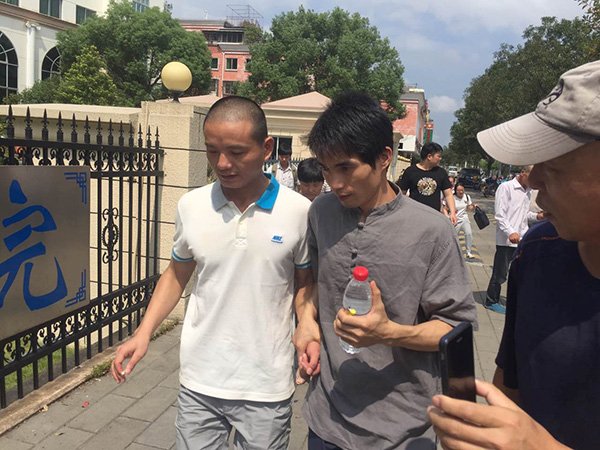
On the day of the verdict, Miao Xinhua wore a white T-shirt and had a buzz cut. When he was brought into the courtroom by bailiffs, his restraints were removed. Throughout the proceedings he remained calm, and even upon hearing the word “acquittal,” his face showed no excitement. After walking out of the courthouse, he accepted a cigarette and was surrounded by family members as he left, never opening his mouth in response to reporters’ questions.
When he returned to his home in Zherong, the Miao family, following local custom, had him “step over a fire basin” to symbolize a farewell to past misfortune. A neighbor shook his hand and said, “Xinhua is back,” and he smiled. But behind the smile was a shattered family: Miao Xinhua was 27 when imprisoned, with a wife and a young daughter; by the time of the retrial he was over forty, his wife had long since remarried, and his daughter had grown up without her father. The second brother, Miao Xinrong, had had a girlfriend he was about to marry and a well-running women’s clothing store; after the case, the store closed and the marriage fell through. The third brother, Miao Xinguang’s barbering apprenticeship was cut short, and after release he could only make a living through manual labor. Father Miao Deshu died without living to see vindication, and his ashes could not be interred.
An uncle of the Miao family said something on the day of the verdict that was quoted by multiple media outlets: “Even if the verdict is overturned, this family is destroyed.“
V. Remaining Questions
The 2017 acquittal cleared the legal names of the five members of the Miao family, but the questions left by the case have not completely dissipated.
Who was the real perpetrator? The retrial judgment only found the original evidence insufficient; it did not initiate prosecution of the real perpetrator. No public reports have disclosed subsequent investigative progress. The victim, Yang, was pregnant and was dismembered and discarded on a desolate mountain; her death has to this day no legally confirmed answer.
Where did the “three hairs” come from? Regarding that mitochondrial DNA appraisal that appeared “just in time” before the second instance, public materials lack further explanation of the source of the samples, the chain of custody, and the compliance of the appraisal process. Lawyers pointed out its scientific inadequacy, but no accountability or investigation conclusions have been seen regarding how that appraisal passed the court’s review at the time.
Were the torture allegations investigated? The five defendants recanted in court at first instance, claiming torture, and the retrial judgment also found the legality of the confessions questionable, but no public information has been seen regarding accountability for the investigators of that time.
This case occupies a rather special position in the sequence of wrongful convictions overturned in China: it was not a single wrongful conviction, but five male members of one family simultaneously swept up and imprisoned together. Miao Xinhua went from death sentence to suspended death sentence to acquittal; his father died after release but before vindication; his third brother’s youth was consumed in prison and in appeals. As lawyer Mao Lixin said: “Unlike any previous wrongful conviction, this one led to all five male members of one family being wrongfully imprisoned.”